

“Sometimes we are on a collision course, and we just don’t know it. Whether it’s by accident or by design, there’s not a thing we can do about it.” It’s one of my favourite lines from one of my favourite movies—The Curious Case of Benjamin Button. It comes right before one of the most gorgeous scenes in cinema I’ve seen, not because of coincidences, but because I really believe in collisions.
Red lights. Missed alarms. Rebookings and cancellations. People finding or re-finding each other. Blocked roads. Walking through two-star towns or eavesdropping. I believe in spring every year, and I believe in expiry dates. I believe in wintering too. I believe in a message that can change your life and a dozen others that don’t mean anything. I believe in green lights and random affinity. I have to, otherwise what option do I have?
I believe that all positive events should be welcomed with force. But also that a negative event should try to change your life for the better. Amor Fati, as Nietzsche called it. The blazing fire makes flames and brightness out of everything thrown into it, said Marcus Aurelius.
Don’t get me wrong, I also deeply believe that man is by nature a sedentary creature. We like not moving. We are comfortable creatures. Once hunting is left behind a man can spend a lifetime defending his little patch of earth fencing himself off from others with walls sometimes 3 or 4 meters high watching Netflix, sipping endless tea or scrolling on the phone, or all three.
But a man can be the opposite of sedentary when he feels something higher than himself, like love, courage, goodness. The things that we find only by collision. They can come by luck, when preparation meets opportunity. But many others they come in our own free will, the greatest common uncommon. I also believe that free will is nothing without curiosity.
Collision is to get out of our way and finding that getting out was the right way. It’s all valid, it’s all fair. Sometimes our childhood mark the greatest collisions in our lives. Some others collisions are marked when we detach from our identities. “Come what may.” Collisions are about living more. No matter the way, we owe it to ourselves to find them.
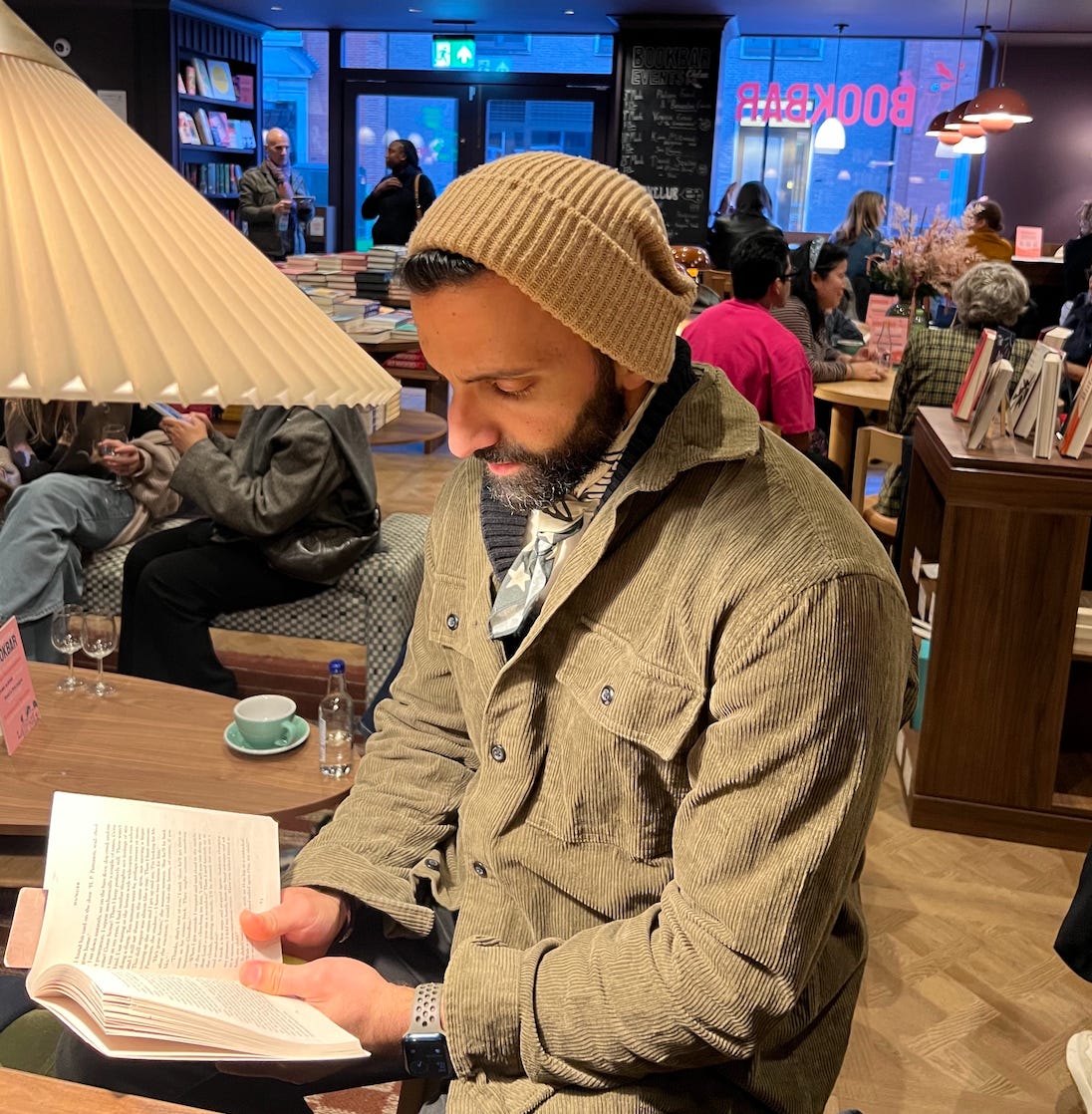
Collisions reveal when we hunt them. To make sure that whatever you want from life, you are also giving it back to find it. It means that you have to focus, and keep focusing. To read a book is a form of collision, and in this reading list I fixated in learning how to perceive and improve the ones around me.
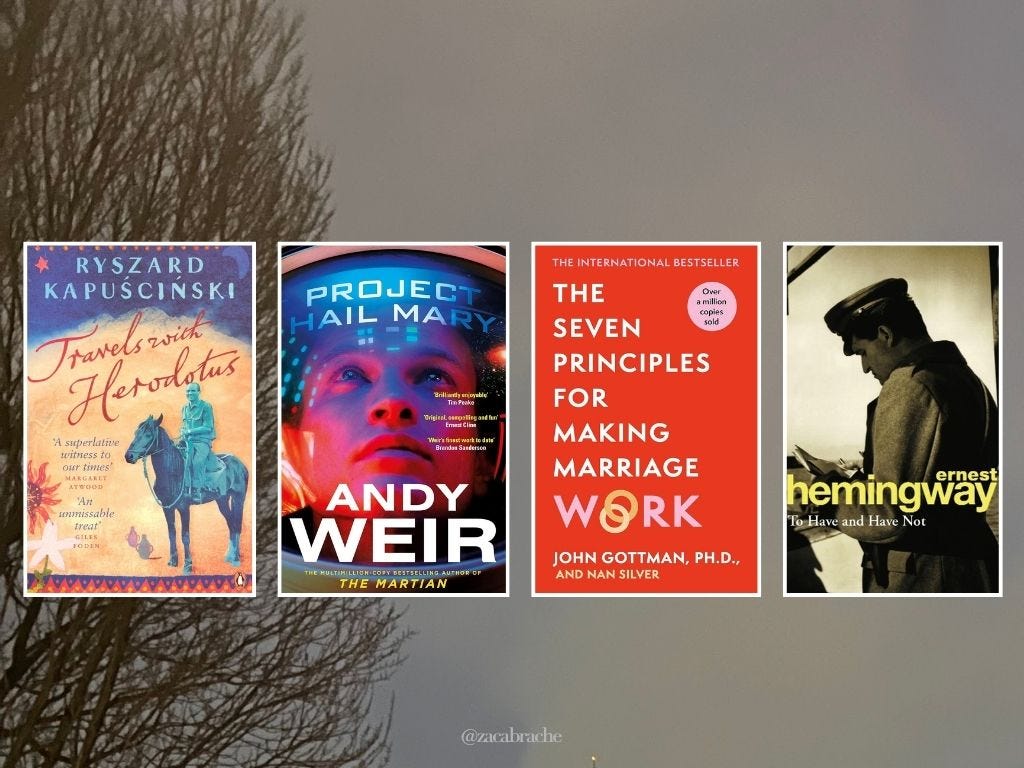
Travels with Herodotus by Ryszard Kapuściński - “The past does not exist, there are different renderings of it,” and this book is about the importance of the one that came first. It’s the 1950s, and a repressed Poland becomes the environment for a man who has never crossed a border, is summoned to cover a foreign event. As Kapuściński sets out, he receives a present from his editor in chief: The Histories by Herodotus, the first travel writer ever. He wasn’t aware of Herodotus, and much less aware of how much of a mirror a man born in 480 BCE could represent to him—a complete expansion through time. Taking his first plane ever and writing his experiences in Asia and Africa, he thinks about the first writing traveller—there were no planes back then, no phones, no easy translations, no borders, just tribes and stories told by night. It probably took Herodotus weeks, maybe months, to get to the other side of an unexplored earth that ended after Asia. Like the journey of a hero into the unknown with strangers along the way, why would Herodotus want to do it? “The purpose is to prevent the traces of human events from being erased by time,” he begins in The Histories, “and to preserve the fame of the important and remarkable achievements produced by both Greeks and non-Greeks.” How fleeting is memory, how fragile it becomes when we don’t learn and obsess with it. By reading Herodotus in his journey, Kapuściński summoned us to a different one, that of reminding us that it’s the disposition towards others, the curiosity about the world, the seeing instead of looking and the listening instead of hearing what makes an individual outlive his rare existence. Herodotus was asking the world the many versions and many stories, and with it, creating the first descriptions of our differences across borders, not by condemning, but rather by understanding them, since that’s the richest way to blend us together.
Project Hail Mary by Andy Weir - This novel is about a man who does the impossible by going to Space to save Earth. I don’t mean it in a Sci-Fi way, but also for you as a reader. Not because of the chance to Space Travel beyond anything we know, but because this novel so meaningfully challenges one of the things we are hurting each other the most today: apathy. Yes this is about crazy stuff and planets and aliens and a man who seems to know it all. But Weir makes you believe so much in what’s on the other side: the courage of doing the right thing, the power of friendship, and the solid hope that only comes when we work together. It’s impossible to see it today because we are just so surrounded by the lack of caring and full of scrolling on world crises and each other’s lives and problems. It’s possible when your reading shows you how easy (and real) it can be. In the novel, there’s also a sudden realisation of how human and alien are so strikingly similar in thinking, in both technologies and learnings, the human asks why, and the alien responds that it has to be, “or you and I would not meet.” If the human or alien had less science, they wouldn’t be able to make the spaceship to meet in space. If on the contrary, they had more science, they wouldn’t have bothered to come and find a solution outside their system. They both had the courage to be there too. They collided. This is so meaningful to me because both in the novel, as in life, we all meet and stick to each other when we are on a similar journey—in what we know, what we are passionate about, and what we find challenging. We meet people for a season or for a lifetime. Friends, relatives, people who we call family, we are all in there. But we could perfectly just miss each other if we miss the learnings, if we decide to miss the world. This is why apathy cannot reign. The movie adaptation with Ryan Gosling is also incredible and made me so curious about the art of translating a book to a script, completely different but equally imagined.
The Seven Principles for Making Marriage Work by John Gottman and Nan Silver - You’ve had the same argument again and again with no resolution. Neither of you can address the issue with humour, empathy, or affection. The issue is becoming increasingly polarising as time goes on. Compromise seems impossible because it would mean selling out—giving up something important and core to your beliefs, values, or sense of self. These are four signs of what gridlock means in a relationship, and it’s one of the principles that you can learn how to solve from this book. I find it pleasurable to read things that teach me an opposing view to what I believe, especially those I can apply and change immediately, those that are very much controlled by our individual actions—this book is perfectly one of them. Gottman and Silver created a methodology that refutes a big part of what we know about counselling a relationship, couples therapy and what we perceive about others in discussions and also in the good times. From the bids underneath our attitudes to signs how to predict a divorce, including what they call the four horsemen: criticism, contempt, defensiveness and stonewalling. I think this book also applies for friendships and every important relationship in your life, as the ways we treat each other are equally appreciated and perennial. Just be aware, this book is both hard in truths and also as a homework—it contains a large list of questions to do for yourself and also as a couple. With my partner we did a group of questions and we had fun in realizing how much we know each other. But even if you don’t do the questions I think is a great piece of work to learn on how to be better in your relationship.
To Have and Have Not by Ernest Hemingway - So I grabbed this book and I didn’t put it down in three days. You have to understand that the first line of every Hemingway book captures you in a chain of nonstop events. If there is one thing about reading him is that the man goes hard in the outcome that you don’t expect, and this book doesn’t disappoint. This short novel tells the story of a fisherman in Cuba whose life takes opposite turns when he makes dangerous decisions, and his life starts to change overnight. It’s also the same type of man that Hemingway usually writes about, a tough, disillusioned, but also resilient character that constantly debates his values and embraces you in his journey. What strikes me the most is how there are conscious moments in the writing where each character is very conscious of what could be the consequences of their actions, and it describes so vividly the reasoning to do them, with you staying in the feeling. I still can’t believe how he wrote a letter to Lillian Ross in 1948 saying that he had to cut 100,000 words from this book, “that may be part of what offends people.” To Have and Have Not is a novel full of surprises and it reads like a movie. Then I researched and it was actually made a movie in 1944 staring Humphrey Bogart, but the setup was changed to Martinique instead of Cuba because American president Roosevelt vetoed the latter, crazy! What excites me about reading Hemingway is the chance that there is more to read, and even more, to reread, as I always discover some new trick in his writing. This is a classic for its own sake.
I’d love to hear your thoughts on these ideas. The best books you can read come to you through word of mouth, so if you know good titles that relate, please share them! If any of these resonate with you, pass them along.