

There’s an old fable about a monk who went for a walk in the woods, and paused to listen to the lovely trilling of a small bird. When he returned to his monastery, he found nothing but strangers there. He had been gone fifty years.
Every four minutes it mirrors the sequence. In the evening view from my balcony, at each side of the lane in the distance a train brakes in hypnosis over and over. I am staring higher up to the vacant sky waiting for the eclipse.
It’s with the train brakes echoing that I sit right here in my patch of predicted light with my 99.9% safety glasses from the ‘harmful ultraviolet and infrared radiation’ or however evil that we otherwise could describe as a perfectly rounded Sun. In between there are empty side streets, with ordered clay roof tiles and old trees and I am looking at the doors of each opposing building, wood panes opening and closing narrating people’s lives in their own Schrödinger cat boxes. It was also later on that Schrödinger also wrote: ‘This life of yours which you are living is not merely a piece of the entire existence, but is in a certain sense the whole.’
What’s the whole, you might ask? Quantum physics, myths to live by, universal consciousness, frozen minutes, chance. Surely an accident, a collision, or meeting your loving ones for the first time. Crafts that have a certain imperfection that have an appeal for that very reason—more than fully realised works. An open-heart moment, the wrong exit, or the Moon blocking a Sun in the vast sky while meeting with my filtered eyes. Could Schrödinger have referred to that?
There’s a movie I’ve watched three times throughout my life. The first time was when I moved out of my country. A young me sitting on an almost empty flat freshly painted with cream walls, overseeing the highway cutting the horizon fed with noisy bus lanes with a view towards the sunset. It was my first and last time departing home and I was looking for a medicine for a never-ending grief. I was missing my family. What’s your most precious possession? I was irredeemable alone with myself.
The second time I was overworked and lacking soul, it was the third month being homeless, sleeping on an air-mattress at a friend’s place. I was Sherlock interrogating myself with waves from a painful breakup in the heart of a pandemic in a room that wasn’t mine. I was held by my night table that was not only my suitcase but also the workdesk where I kept typing from.
The last time was this past month with my girlfriend. I’m in London now. The eclipse starts to shade and the Moon and Sun become one. Frozen minutes. I told her we are watching one of my favorite movies. The same movie but three different versions of me. I actually realised that it was my favorite movie gradually over thirteen years but I didn’t know why. I kept asking over and over.
Is it because of the sense of adventure that Walter Mitty breaks into living his monotonous life, a Hero’s Journey on its own? Out of the loop and expanding himself. Or was it an act of courage? The fear of love? Maybe the mountains and scenery? It couldn’t have been redemption, I know it pretty well. Maybe it was the clock intro, the piano, the guitar notes floating in the space? Or maybe it was José Gonzalez making me feel invincible with his singing: ‘Step outside, time to step outside, house on fire, leave it all behind you. Dark as night, let the lightning guide you.’ Challenging the gods like Odysseus himself. I think of the house on fire as my old beliefs and how I kept burning those bastards when I moved young and again later on, and how the new ones learned how to be done and give room to whatever may come.
Then I realised this moment watching it the third time, close to the end where a camera is set steady for many hours, even days, still on top of a mountain waiting. And the perfect shot is waiting to pose like those who saw it with their eyes hundreds of years ago and will see it again. And when the snow leopard appears, Walter asks ‘When are you gonna take it?’ And Sean responds ‘Sometimes I don’t. If I like a moment… I mean, me, personally… I don’t like to have the distraction of the camera. I just want to stay in it.’
‘Stay in it?’ Walter asks.
Unmoved with a gaze almost dream-like, Sean responds ‘yeah, right there. Right here.’
How crazy is it that such moments feel like a known chain of events in your body? It’s not muscle memory, it’s not intentional. It’s not from this world, it’s something different. It’s a throat feeling that magically appears in the form of tears. It’s a flame that lightens your belly and tells you you’re human. It’s something or someone pressing a button, pulling the curtains, taking it off the hat, pushing you at the cliff, and you can’t stop and you are in free fall and I swear that for the third time I can see my whole life on it in seconds. Snow leopard moments flash through and become fleeting, unseen, relentless. Moments for oneself and many with others. Things that I was able to see face to face, and those that I missed. Pendulums that never stop with the reminder that the past is never dead. In fact, it is not even past.
I keep counting every four minutes, in its fast track a train stops over and over. I’m on my balcony and the Moon is totally eclipsing the Sun and the time stops. I don’t hear the train anymore because a shadow is shouting, setting everything in slow motion with slow winds and slow trees and a slow train orchestrated by a universe that seemed to already know what would happen before it had happened. I turn around and I see in the distance the park with small groups of people staring or trying to stare at a soft Sun with sun-glitters nearby floating in front of me craving for attention while I’m with the memories fleeting, right here. Right here.
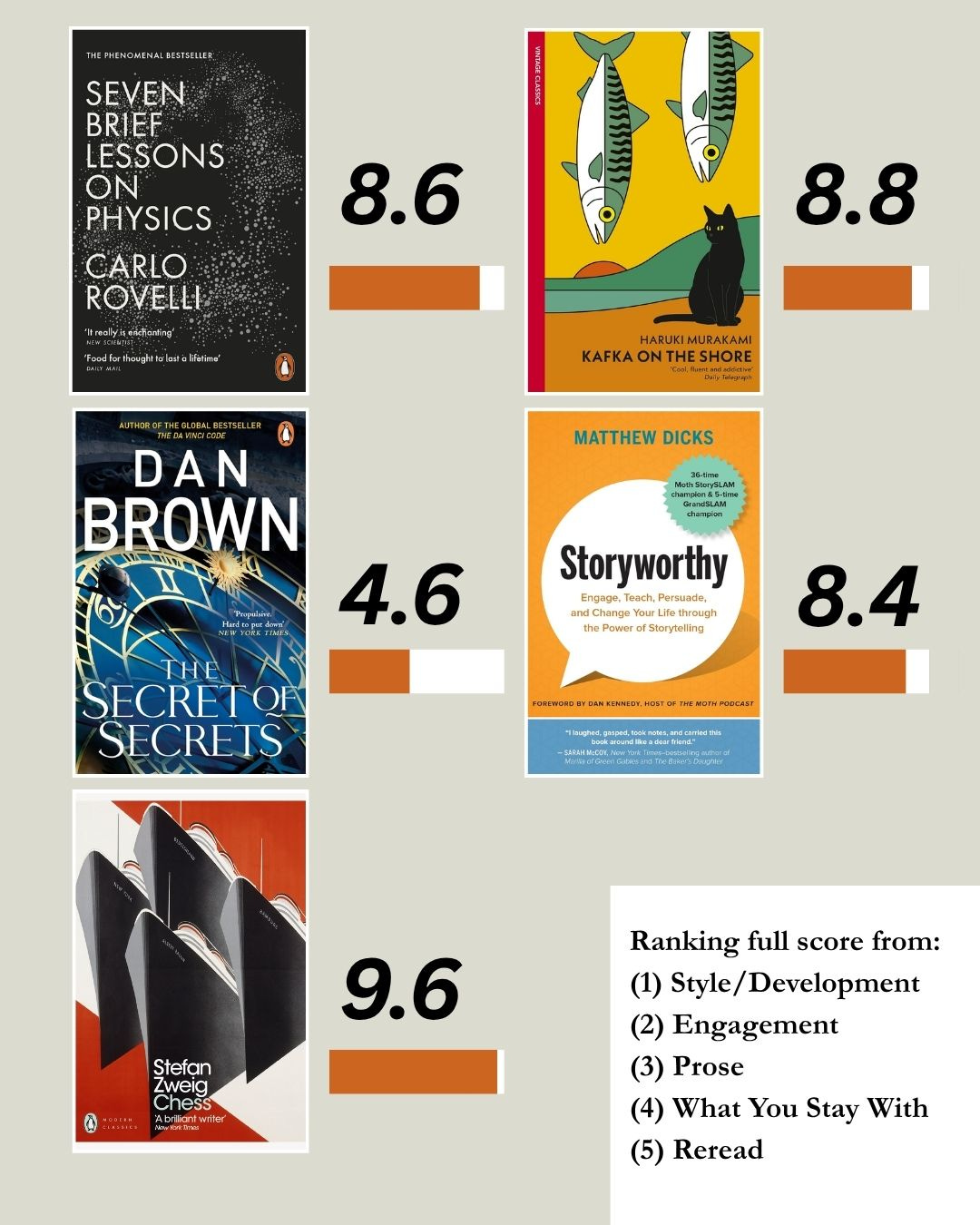
Seven Brief Lessons on Physics by Carlos Rovelli - I read once that the best way to understand the world is by going back to the fundamentals. Say, mathematics, it’s better to be really great at arithmetic and geometry than to be deep into advanced mathematics. And if you start with the originals as your foundations, then you have enough of a worldview and understanding that you won’t fear any book. Carlos Rovelli did this magical thing with physics in this book in the shortest and most entertaining form. I love physics but it’s one of those subjects that can be very daunting to understand. And in the decent sum of a few hours, I was able to read this book and understand the most wonderful things about physics, of the past, starting from the Greeks, all the way to Einstein and modern physicists, deciphering the mysteries of the universe. I learned about the universe expanding like the surface of the sea. I learned about two theories that changed the twentieth century: general relativity and quantum mechanics, and also their contradictions. I learned about the quest related to heat and time, facing each other as clues of what scientists are trying to uncover next. The book closes with the seventh lesson, a reflection of ourselves, and a quote from Lucretius, written at least 55 BC, claiming that ‘we are all born from the same celestial seed…’ and I went to bed excited, realising how little I know about the universe and our oneness with its mysteries, how much we have to discover, thinking about those who came before us and those who are coming after.
Chess by Stefan Zweig - This is one of the greatest and shortest books and I can tell you that’s also one I’ll be thinking about for a long time. A suddenly rising world chess champion blind in his own perspective and odd upbringing, boards a cruise ship for Buenos Aires and this book tells the story from the point of view of one of the passengers who is eager to play him. After an expected defeat of the passenger, the rematch takes a twist when someone else in the crowd whispers the perfect move surpassing the skills of the world champion. I felt unexpectedly captured by Zweig’s prose and urgent-like style telling a story full of obsessions and the things that we could lose ourselves in when we have nothing left to lose. One of my favorite parts was my experience as a reader flipping pages over and over the descriptions of a man’s thinking in confinement. It’s almost as if you feel you’re confined yourself and I could hear myself saying wow, wow, how is this possible? ‘The more a man restricts himself the closer he is, conversely, to infinity.’ Zweig is one of the most interesting writers I’ve learned from, as his previous works for me have always been in the realm of short but meaningful biographies, as if told in his own words, capturing all wisdom, such as the one for Montaigne that I reviewed in another reading list some time ago.
Kafka on the Shore by Haruki Murakami - ‘Time weighs down on you like an old, ambiguous dream,’ writes Murakami through this surreal novel that might be one of my favourite ones this year. Placed in modern Japan and blending multiple storylines, Murakami describes the story of a 15-year-old that escapes a fractured home from his dad to evade the ‘Oedipus’ prophecy—that of the Greek hero who kills his dad and sleeps with his sister and his mother. It becomes a somehow twisted perspective from which the boy seems to be falling despite doing the right things he feels should be doing. While—at the same time—another story emerges in parallel from an older man whose own life was fractured by supernatural events when he was also younger, opening a dimension with a different identity and capabilities that he just follows as if they were set up by fate itself. In both journeys, the two seem to face completely different challenges and people that support them along the way, like waiting to be awakened from their pasts to do what they have to do in those precise moments, and the connections start to develop in a cosmic dance of dreams and reality. What I liked the most was how sensational everything became in a light read until it wasn’t. I felt that Murakami kept attributing a sense of oneness in all the actions we do, but kept grounding it with a remarkable exploration of one’s identity through myths and that which we ordinarily feel. One of my favorite concepts of the novel was learning how Aristotle argued that the sense of tragedy comes through our own good qualities. How, for example, Oedipus actually makes his prophecy by being courageous and honest. Or in a much more relatable way, how our challenges arise not by becoming still, but by our sense of duty, virtues, and doing goodness in the world. This is why it turns as an irony to face, which ends up deepening ourselves as human beings, finding a sense of sweet redemption on the other side of most of the stories that we like.
Secret of Secrets by Dan Brown - Brown usually doesn’t disappoint by wrapping his novels in subjects that we usually don’t know quite about! Giving you a glimpse of the fascinating things that have been discovered through pseudoscience—that which doesn’t use proven methods to test or validate results. When I was in high school, Dan Brown was a sensation for me. I used to be fond of all the things that I learned from his books towards science and religion and how they juxtapose—mostly through the Da Vinci Code and Angels and Demons. Respecting the fact that Brown spent eight years writing this novel, it is quite admirable, but having read this new novel so many years later made me wonder whether his writing hype was something I truly admired. The plot this time around was surrounding life after death and the unexplored revelations about our brains. I loved his thorough research on Prague and I was fascinated by the history of many famous spots in the city. I was impressed by his point of view on religions’ position towards death, as he pointed out to Upton Sinclair mentioning: ‘fear of death is the father of religion.’ How little we still know about the brain and conscience, and what are the grand hypotheses that might change everything we know about the afterlife—These are some of the powerful questions that the book explores. In a traditional Brown style with secret organisations and high entities fighting for power over research and control, action scenes and hidden plots that build up, I found myself highlighting interesting facts and getting entertained with the main character—don’t get me wrong, I love Robert Langdon! But when it came to the plot and narrative, I wasn’t enjoying it. I recognise novels I enjoy with undefined mystery, dive in character development, and prose in their writing, but after a certain point with Brown, the novel was the kind that doesn’t leave much to imagination and felt quite predictable, pointing out how you should question, feel, or believe. It made me wonder whether I should reread the Da Vinci Code or Angel and Demons to understand whether the literary style has changed.
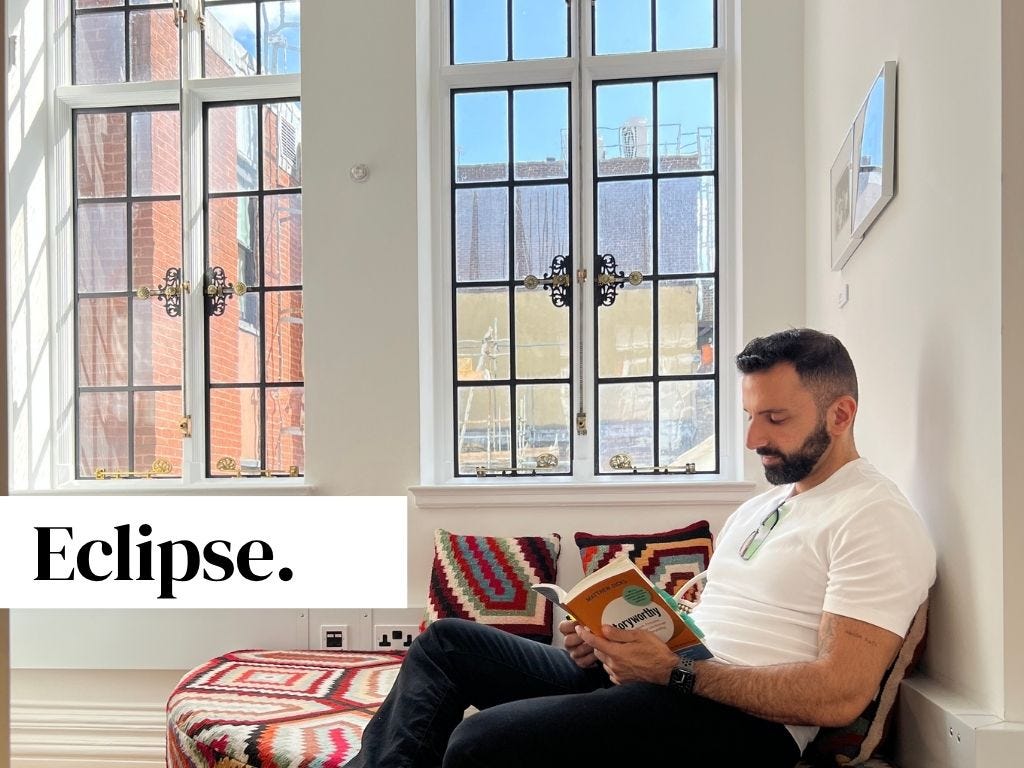
Storyworthy by Matthew Dicks - Once a year, I try to reread books that I felt changed my perspective about how to think about certain habits or ideas, and this is one of my favourite books. I posted about it in books that changed my 2025. This masterwork is a guide to tell better stories. Dicks is one of the best in the storytelling world, which actually has a famous competition called ‘The Moth,’ and I find that the book is a Bible about how to do it yourself. He breaks the book in three parts: finding your story, crafting your story and then telling it. In each part there are so many examples and tricks broken down to the method (I am very methodic so this comes as a great pleasure!). Similar to my review last year, one of the most pleasurable moments I found again was the fact that every story tells a five-second moment that changes a person’s life fundamentally. They happen daily, they don’t have to be big moments or weird events that only happen once in a lifetime, but the only key focus needs to be a moment of ‘change.’ Utterly human moments from which you might be looking at things with a fresh perspective after: ‘I was once this, but now I am this. I once thought this, but now I think this. I once felt this, but now I feel this.’ The fascinating part is that most of the things we watch on TV and probably know by heart have some sort of relatedness to this. What the storytelling helps us do is bring that moment to the greatest clarity possible, guiding the audience as if you were the movie director with all the tricks and things to avoid. Yet only if we try to practice looking at these moments in our daily lives will we be able to see them. Our own lives are full of moments that can light a cinema or a dinner with friends, and this book gives an incredible perspective on how to make that moment be savoured.
As usual, I’d love to hear your thoughts on these ideas. The best books you can read come to you through word of mouth, so if you know good titles that relate, please share them! If any of these resonate with you, pass them along.