

She visited Japan for months to study the language, a hard one to learn. In her second period, they gave her a volume-sized research to interpret—something from a PhD, a brick-like slab of paper. A friend of mine she is, and her task was insanely hard, and as she read the text and mumbled the first characters known, she complained almost immediately. The teacher turned to her and pushed back with one of the most fascinating words I’ve learned recently: Ganbatte, to do your best, to work hard, to keep trying.
I don’t know if it is a word solely in Japan or if it relates to expressions in Eastern cultures. I don’t know whether it’s Confucius speaking to us across the centuries, spreading philosophy across the ages, or whether there’s an East-West difference in perspective. I don’t take it further to understand where it’s coming from, nor did I ask her what happened next. I settled on it. I just know that we need more of that.
Ganbatte, to try hard. Ganbatte, to find ways to figure it out. Especially on the things that we are passionate about. Things that we come back to regularly, even in our highest, even in our lowest (especially in our lowest). Because hard acts will always bring so much reward.
Learning something new.
Going the extra mile.
Doing the right thing, even more when no one is watching.
One example is all the wonderful things you get in reading a long and hard book. On the one hand, you’re finding yourself learning and exploring what a 20 second video can’t give you: patience, dialogues, deep ideas, places and historical figures you didn’t know about. On the other hand, you get to capture your own essence of what the author meant, building your own wisdom and creating your own debate, finding yourself in pages that are long and complicated on their own, while searching for the tools you have to make it through.
Ganbatte to read the footnotes that couldn’t fit in the large text. Ganbatte to debate the sources. Yes, argue with the writing. Yes, have that discussion. After all, learning to listen to someone who is different from you is also hard. Opening your mind to new ideas and different realities, to a better path—maybe harder but better.
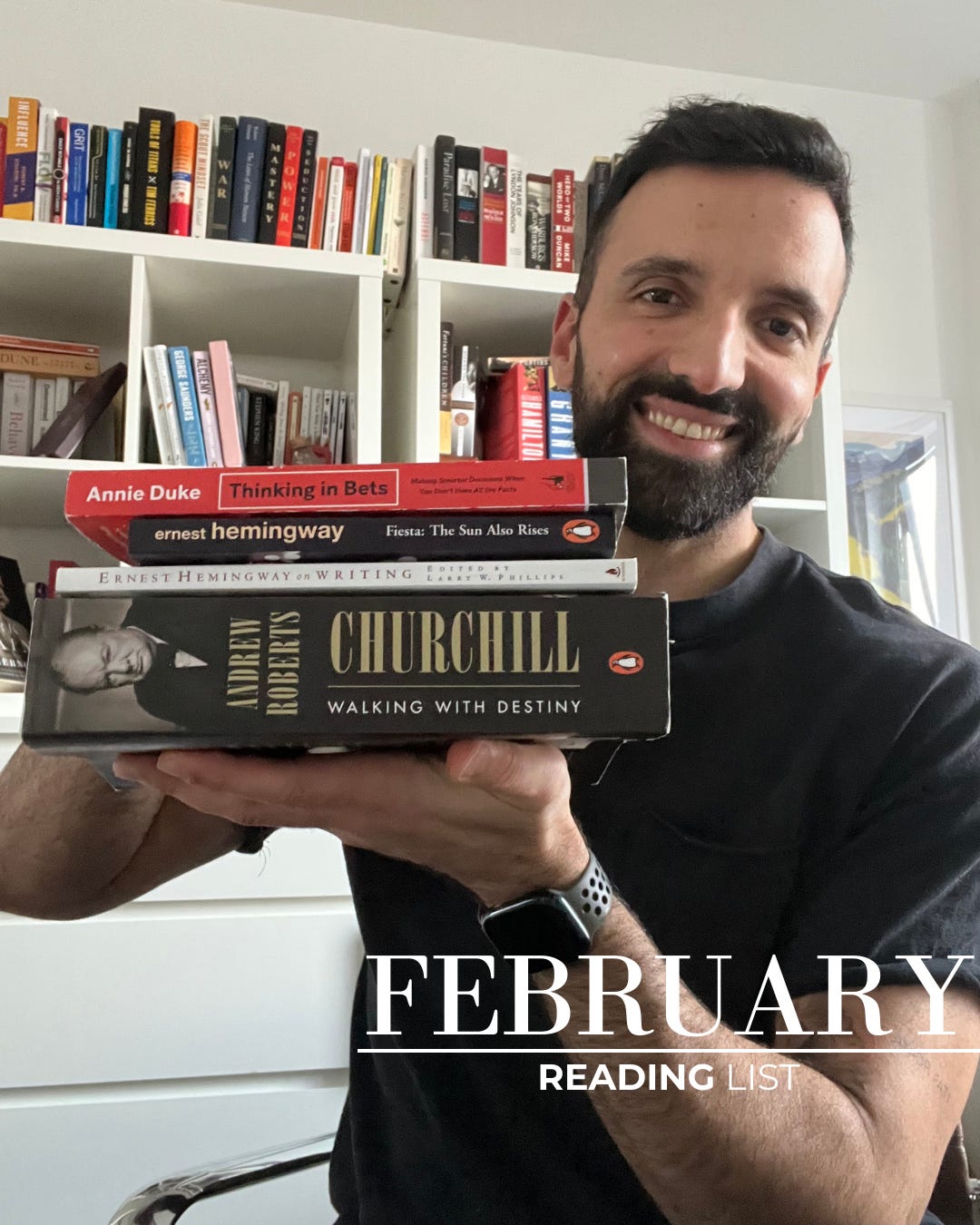
Ganbatte means to learn how to look back… So you can know how to move forward. I found these in what I read this month: a biography of the last English man who believed in the providential duty of the British Empire, and tried hard to save the Western world from fascism, and won. I also read about Hemingway, who used to read his writing 206 times before publishing, achieving immortality, this time translating the confessions from fiestas at night into fiction, along with some favorite ideas on writing. I also read of an incredibly smart woman that built perspectives from trying hard to have something and not achieve it, using one of the games in which uncertainty is the command: poker.
Churchill: Walking with Destiny by Andrew Roberts - 1,000 pages chronicling a man of grandiose vision and a sense of duty and honor for the English people. We could argue that being born as an aristocrat can take you far in life, but Churchill just reminds us of the uncommon example, doing the most you can with everything you have. Born when Queen Victoria was alive, at sixteen he told a friend that “London will be in danger and in the high position I shall occupy, it will fall on me to save the capital and save the empire.” So strong in his convictions and belief of himself, that not much later, he enlisted himself as a British soldier and war correspondent, then coming back and rising in the House of Commons as an MP, and later cycling in and out of high government positions… finally becoming a Prime Minister twice, the first at sixty-five during the Second World War, exactly what he has dreamed for himself half a century earlier. He was a mortal, a human being, an ordinary man, yet he never decided to have a day idle. Never a skipped experience, never a sense of wintering—there’s not a page in this book where you find that he woke up one morning and decided not to push himself with contagious energy. What’s more is realising that much of his reputation came from being a writer, publishing thirty-seven books with 6.1 million words, more than Shakespeare and Dickens combined, and over 5 million words in speeches that steered the nation and even the world with hope, especially speeches made during the war. “A speech by our beloved Winston Churchill is quite perfect,” wrote Anne Frank in her diary in 1944. Churchill was sometimes also controversial and contradictory in his views on liberty, India, philosemitism, eugenics, and even the aristocrats themselves, but this book tells the story, success, failures and learnings of someone who left a permanent mark on European history. There is so much to learn from a polymath who, as his daughter Mary pointed, saw “events and people as on a stage,” constantly telling the British people that they have been there before in the past, asking himself “what must Britain do now?” He was a man the British people ended up trusting for the premiership in 1940 not because he was right in the past, but because they believed he had been consistently true to his beliefs. There are so many things I learned from this book about British identity, global history and a deep insight into both World Wars, but also about how far one’s own willingness can mark your contributions in life and the path you end up taking.
Fiesta: The Sun Also Rises by Ernest Hemingway - Fiesta is a novel about someone who only wanted what they couldn’t have. Surrounding cynical, complex and unresolved characters, describing the fictional experiences of an expat in Paris in the 1920s, and the relationships with his friends living their own challenges: impossible love, jealousy, irony, emotional fallouts and a lot of drinking. It is said that Hemingway wrote this in allusion to his own life, as part of America’s “Lost Generation,” or those who came of age after the First World War, giving a hollow meaning to purpose, patriotism, and heroism. Instead, choosing a life away from America, filled with parties, alcohol, and affairs. A sign of a fleeting and less judgmental life, yet facing the same questions over and over: what is immoral, what is not, and could falling in love all the time mean that your values are dead? As they travel to Pamplona for the San Fermin fiesta, Hemingway describes every setting and every character with great passion, but with so much conflict… that you finish the book wanting more. “It was like certain dinners I remember from the war. There was much wine, an ignored tension, and a feeling of things coming that you could not prevent happening.” A highly recommended read to confront human nature and the decisions we make and want to avoid making.
On Writing by Ernest Hemingway - “You just have to go on when it is worst and most helpless—there is only one thing to do with a novel and that is go straight on through to the end of the damn thing… For Christ sake write and don’t worry about what the boys will say nor whether it will be a masterpiece nor what. I write one page of a masterpiece to ninety one pages of shit.” wrote Hemingway between 1929 and 1934 in letters to F. Scott Fitzgerald who was publishing Tender is the Night. This book is something rather unusual and disrupts one of the things Hemingway was against doing, which is writing about writing. Author Larry W. Phillips spent much of his valuable time collecting Hemingway ideas on the subject from his novels, stories, letters to editors, friends, fellow artists… It’s almost as if Hemingway wrote and talked about writing as he was crafting a novel about it, from his working habits, advice to writers, knowing what to leave out, and the writer’s life, who suffers “like a bastard when you don’t write, or just before, and feel empty and fucked out afterwards. But never feel as good as while writing.” This book feels timely as I always find the same demons myself as an amateur writer, but it’s also a book that makes you feel you’re wearing the shoes of a human who won the Nobel Prize for literature just doing the hard thing and achieving it, over and over. There is a mystery in all great writing that Hemingway explains no matter how many times you read it you do not know how it is done, “it continues and it is always valid” he says, “each time you re-read you see or learn something new.” And this is what I feel when I read these capsules from his writing and notes, to Harvey Breit, Fitzgerald, Charles Scribner Jr., and many other journalists.
Thinking in Bets by Annie Duke - All the talent in the world doesn’t matter if a player can’t execute, and execution doesn’t mean having a flawless shot, but rather something earlier—and even more fundamental—that is differentiating the things that you can control from those you can’t. The conscious certainty vs the hidden unknowns. Therefore, the quality of our abilities can show us over and over that the best decision doesn’t yield the best outcome every time, and Duke shows us that her life experiences are an incredible example. This is one of those books that you want to keep for reference and maybe read once every now and then. Drawing the differences through game theory between two games: chess and poker, she explains how the first one relies on having a clear problem and all the probable solutions on the table board—a fiction. Whereas the second shows you the deceptions, the bluffs, the surprises, and the uncertainty that can explain real life. Every decision we make is a bet against all the future versions of ourselves that we are not choosing, and through a series of realisations she walks us through meaningful perspectives like how most of our happiness mistakenly derives from comparisons instead of our own needs, or how we build the wrong beliefs and stick to them, or how emotions derail us, or how, in the words of Aldous Huxley, our experiences end up being not what happen to us, but what we make out of them. Could you be creating your own chess board? From the environment you create when you learn something new—or challenge it—to how you reinterpret the outcomes, to whom you follow online and whether unintentionally they all reinforce you with the same opinion. We all have something to challenge about ourselves. Otherwise, as she asks of the risk that I’ve seen so many be in, “what forty-year-old thinks everything they believed at twenty is still correct?” She brings so many good tools to help us discern between the quality of a decision and the results of that decision. Learning about them helped me feel more humble and connected to the choices I make and those from the people surrounding me.
I’d love to hear your thoughts on these ideas. The best books you can read come to you through word of mouth, so if you know good titles that relate, please share them! If any of these resonate with you, pass them along.
This was a fantastic curation, Zac. Your opening on Ganbatte really set the tone; it’s a perfect lens for looking at the 'brick-like' books we often avoid but ultimately gain the most from.
I especially loved the connection you made between Churchill’s 'not a day idle' energy and Annie Duke’s focus on the quality of decisions versus just the results. It’s a reminder that even when we’re operating in a 'poker' world of uncertainty, the effort (Ganbatte) is what keeps us grounded. Regarding your question about what we believed at twenty, I think the biggest shift is moving from 'chess' thinking (where I thought I could control every outcome) to accepting the bluffs and surprises of real life.
Since you asked for word-of-mouth recommendations, I highly suggest 'The Demon of Unrest' by Erik Larson. It fits your interest in pivotal historical moments and high-stakes decision-making perfectly. It covers the five months between Lincoln’s election and the start of the Civil War, a period defined by extreme uncertainty, polarized 'beliefs,' and leaders trying to navigate a situation where the 'right' outcome seemed impossible to guarantee. It’s a masterclass in seeing history as a series of high-stakes bets.