

I was very excited to post the eleven books that changed my 2025 in one of my last reading lists. A summary and a closure. I gained a lot of traction and meaningful conversations in 2025 by repeating my goals every month: publishing my reading list and sharing short essays. Sometimes easy, sometimes hard and unknown paths that get enabled just by trying to understand the creative work—that which seems to become available to you or “pending” to do the more you dive into it, action by action, challenge by challenge. Like passages or turns that are hidden and waiting for the ideal time to flourish. Like seeds in your mind.
In The Daily Laws, Robert Greene wrote that people get the mind and quality of brain that they deserve through their actions in life. It is through the creative work that I feel that I have grown. I remember every single occasion I’ve written and published my monthly reading list. My mind changed in every one of them. I felt like a different person after posting about those books, and then I felt like a better one the next month.
What creating does is set me in a state of joy and excitement by telling me how little I truly know, and how mysterious the world remains. It makes me work hard to develop independence in my thinking and patience to make things flourish and ground in silent stillness. The real change happens when you take those things back to the world.
Writing isn’t the only path to this feeling. I’d encourage anyone to do any type of creative activity that makes their mind enter a flow state. To materialise ideas in any shape or form, to get lost in the process. In creating something hard, or harder than our capabilities, we attain something greater in ourselves. I hope you enjoy my reading list this month!
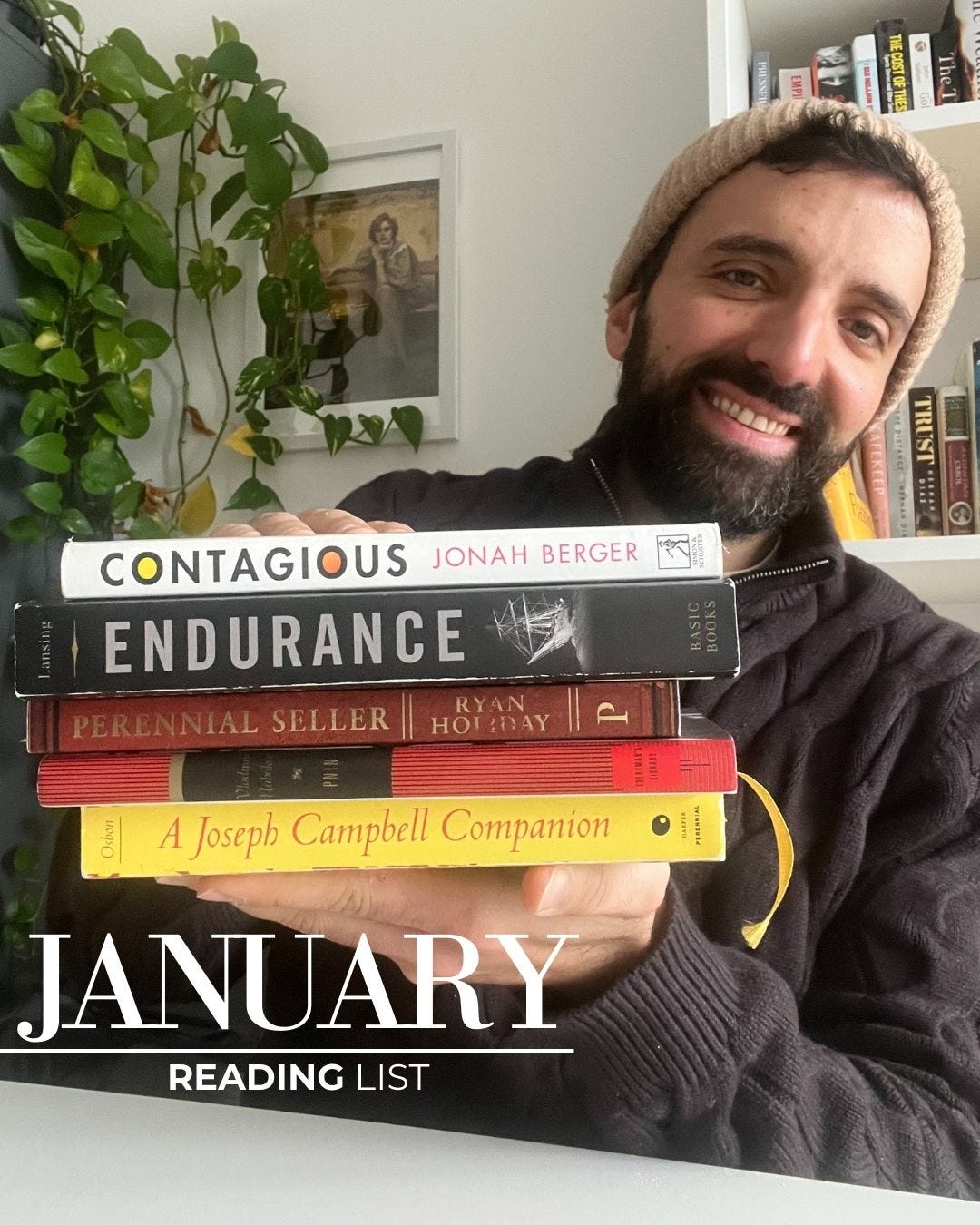
A Joseph Campbell Companion: Reflections on the Art of Living by Diane Osbon - If books are meant to teach wisdom and not facts, this is that book. Campbell is best known for The Hero with a Thousand Faces, which has profoundly influenced many storytellers—even Star Wars was made under this premise. This book collects lectures from an intense month-long seminar and links his most relevant writings, offering fascinating insights on how to live better, from becoming an individual with spiritual fulfilment, taking action and living in wonder, understanding philosophy, art, psychology, Christianity, Buddhism… At some point, he mentions coincidentally meeting a young John Steinbeck and changing his perspective on writing, that’s crazy! I read once that from your own mental level, you can only stretch to comprehend just a bit beyond yourself. When we encounter movement leaders, historical figures, or “enlightened” ones, it’s because they stretched and changed their beliefs significantly upward. Joseph Campbell is one of those people, and in this book, he shows us that the separations and limitations exist only in our own minds.
Pnin by Vladimir Nabokov - “Man only exists insofar as he is separated from his surroundings.” Absent-minded, wronged, unaware of social cues and, most importantly, an exiled Russian in America, this novel is a literary example of a story of character—the writing of a person through a series of anecdotes of his life, but this time taken by an author mirroring himself, Nabokov, a Russian literary genius. He is mostly known for Lolita, a novel about a paedophile’s obsession, a horror written in prose that became a literary masterpiece, disturbing and banned in multiple countries across the world. Pnin, however, was a parallel story that Nabokov was writing backstage, to decompress from Lolita, to look for himself, as if he was exiling from his own exile between works. It was published just a year later, and solidified him as an intellectual in the English literary world. One of the points I was most fascinated by was his allusions to Russian aphorisms and understandings in the American world, among them his comparison of a land father to a water father. The first, rooted in earth, law, borders, and institutions—classifying, misjudging, condescending. The latter being a man exiled and turning inward. Someone who lives with great courage, serenely wise, faithful to a single love. Authentic. Integral. What Nabokov wanted to realise for himself, even in exile, even far from his known self.
Perennial Seller: The Art of Making and Marketing Work that Lasts by Ryan Holiday - Ideas are cheap, do the work. It’s one of the points I realised most from this book. It’s not about learning how to sell your ideas. It’s about having something worthy to sell in the first place. Through four areas: creativity, positioning, marketing and platform, Holiday explores the fundamentals of great content and how to ground it when the world gives you mixed signals, when we claim we want to do something that matters but keep on measuring against things that don’t, when the world is waiting for you to make things that will make it better. There are a handful of books that I reread to realise a snapshot of my growth from time to time and this is one of them. Every time I read it I feel more mature as a writer. One of the greatest lessons I took this time around reading it is that we should make our work as beautiful and emotionally evocative to others as it is to us. Ryan Holiday is my platonic mentor and someone I deeply respect and admire for his ability to move between worlds throughout his life journey primarily as a reader and writer. He has already written 12 best-selling books, covering topics like philosophy, marketing, history, and how to live well, but also every day he writes a small powerful stoic note that gets to my inbox through the Daily Stoic. This is valuable reading regardless of where you are in your creative journey.
Endurance: Shackleton’s Incredible Voyage by Alfred Lansing - “No matter what the odds, a man does not pin his last hope for survival on something and then expects that it will fail.” Those words from Alfred Lansing describe one of the wildest stories ever told. Written in 1959, this novel tells the incredible story of a shipwreck and the leadership, perseverance, and courage of its twenty-eight crew members to survive. There are so many things about this novel that make you pause and appreciate the positive sides of human nature—among them a man’s ability to change his mind, the trust in one another, examples of sacrifice for the greater good—all under impossible circumstances. It was so good that by the end I couldn’t hold it and wept. What I also found fascinating is that this story was written four decades after the incident, discovered by Lansing while reading Shackleton’s memoir. He then began a quest of interviewing the living survivors. His wife later reported that Lansing started “writing obsessively,” a great segue into how he achieved such vivid prose and emotional depth. All said, the book was forgotten at publication, as it didn’t match the interests of the time (Sputnik was launched a few years earlier, sparking the space race in the Cold War). And almost three decades later, the book was republished, selling over half a million copies. The attention to detail makes it a staple in literature. “Only a handful of books are so firmly connected to the timeless underpinnings of life that they survive into the future,” says author Nathaniel Philbrick.
Contagious: How to Build Word of Mouth in the Digital Age by Jonah Berger - A fast, insightful read on marketing—a field that changes rapidly—using very memorable examples grounded in six timeless principles: Social Currency, Triggers, Emotion, Public, Practical Value, and Stories (STEPPS). Have you noticed how it takes forever to pull the cover off the box of your new iPhone? That’s intended—it means putting the customer first with the experience. When was the last time you used your air miles? Probably a long time ago, 9 out of 10 people never cash in the airline miles that they accumulate. What is the last thing you remember buying without seeing someone else wearing it or talking about it? Maybe half of the things, since word of mouth makes you buy things about 50% of the time. From speakeasy popularity to Disney vacations—we see the principles applied everywhere around us. It was fascinating to learn about our competitiveness around consumption, and how we often care more about status than our own individual benefit. Published in 2013, the point of this book is not to make you a marketing expert, but to understand the nuances between good marketing and things that can go viral. In a world where our attention shifts constantly, that difference will help you understand both how marketing works on you and how you can create content that could stick forever.
I’d love to hear your thoughts on these ideas. The best books you can read come to you through word of mouth, so if you know good titles that relate, please share them! If any of these resonate with you, pass them along.