

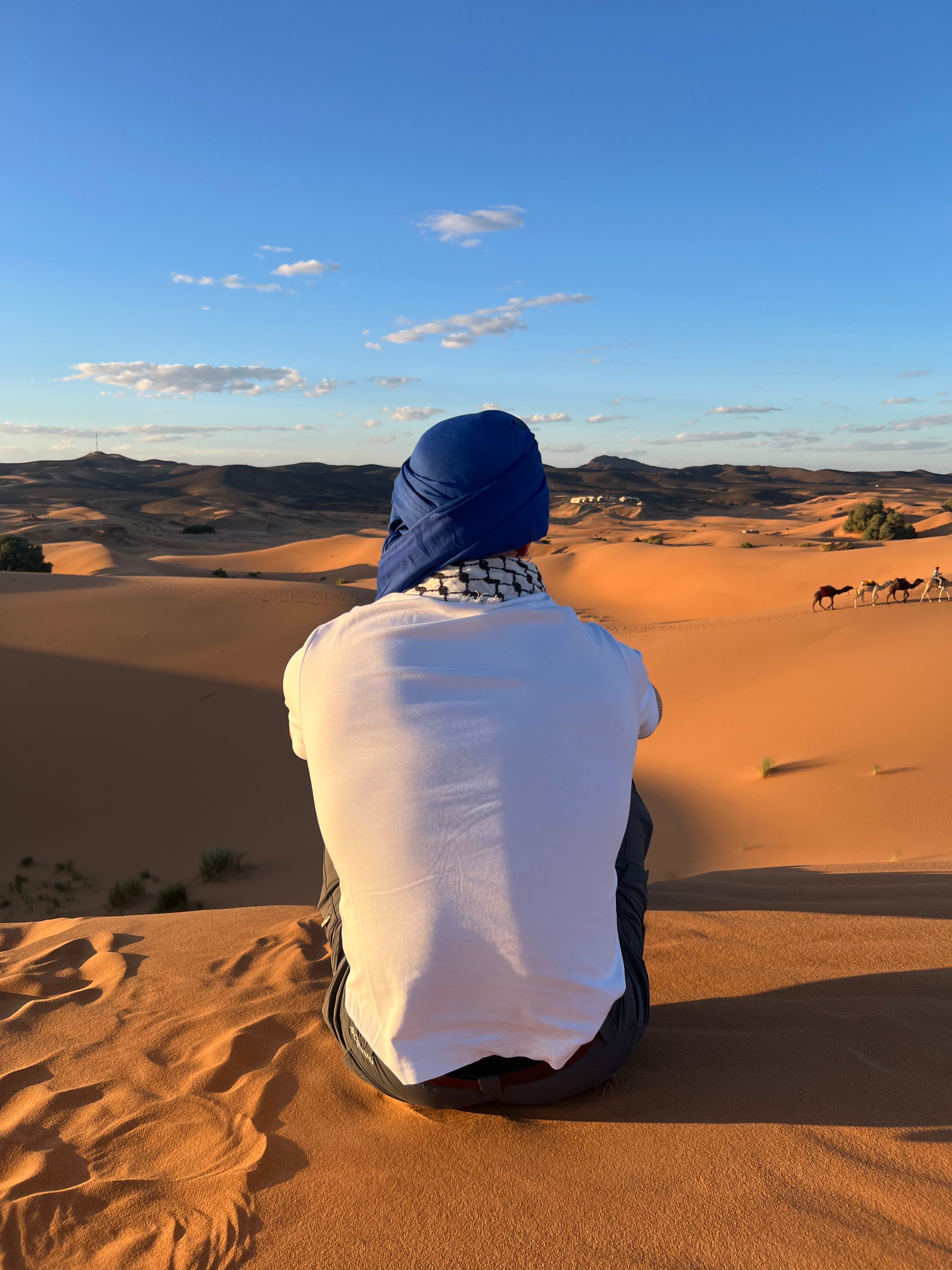
I learned about the desert. I didn’t read about it, I visited it. I went to the Sahara. I was where the silk roads ended, the Atlantic last shop. Remember when you wanted what you have now? I remembered posting that quote once on my socials and people came back thanking me for it. The desert is silent. I was celebrating my best friend’s birthday, and after the drums and the laughs, in the night time if you try to listen, you can almost hear the ground breathing, moving underneath, roots to the heart of Earth. The desert is wise. Imagine years, decades, thousands of years of dunes changing sides, spending time in its own knowledge and fluid lands, hiding the steps of millions of dromedaries, together with the joy, deceptions and heartbreaks that people leave behind. How many secrets the desert holds and doesn’t tell? The desert is also full of surprises. After a bonfire, we hiked and sat on top of a very tall dune into the small hours from midnight. The silence joined me. I raised my eyes, I finally laid back, everything my eyeballs could see were the stars dotted in mass lighting through domes of sand and subtle wind. I lost track of time when our campfire shut off on the horizon and it was us with the moon. Van Gogh said that the night is more alive and more coloured than the day, and I saw it. As if the sky was the theater and desert was acting like a berber pharmacy opening its groaning, protesting metal curtains, showing us its values not in the morning but right after dusk.
The desert teaches you more about water than the ocean ever could. I thought about everything then, the turns of my life, decisions I took and felt proud of, decisions I lamented. I thought about my family, my partner, my friends, the things I left behind, the game of chances, my health, and the art of living. Remember when you wanted what you have now? Now it was too late (or early) in the day but I thanked back. I don’t know what effect this writing has on anyone. I know what it does to me. I was sitting there with people I consider my chosen family. Three hours and a half later I woke up from my tent to run back to see the sunrise. I felt hungover, like trash, but the future me will also be thankful for it. Because moments you lose like that are called “Imitation Art,” something that can’t be timeless like a painting, but rather joined in time, like going to a play and seeing a dance happen. An essence bound in place that if you don’t see it at that point, you just lost it.
I sat on the same dune and I saw the sun rise in the midst of aggressive cold wind. Wind that knew its time was late to hide from the Sun. I sat there until the old sand stayed in place and the heat welcomed my face. It was just me and silence again. Curiously, the friend I was celebrating doesn’t like reading, and he asked me how different my life would be if I didn’t read. I wanted to say that if I didn’t read I wouldn’t be able to live a life on top of a dune at midnight in the Sahara desert, but I was just remembering.
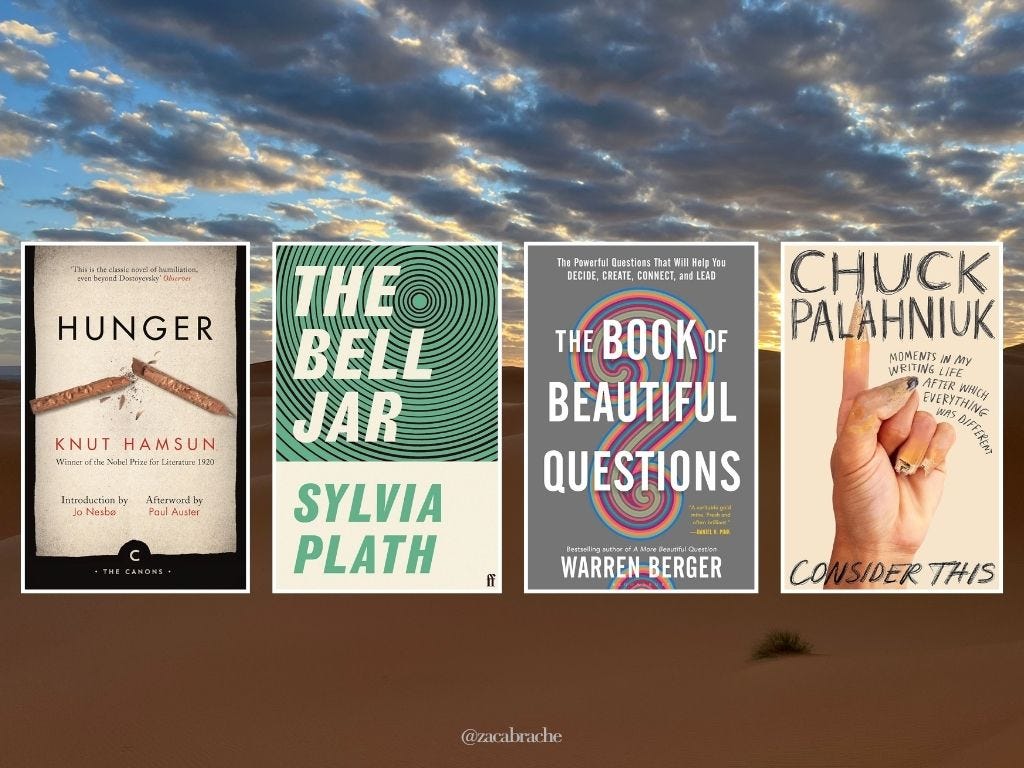
Hunger by Knut Hamsun - “I stuck my forefinger in my mouth and took to sucking on it. Something began stirring in my brain…what if I gave a bite?…I squeezed my eyes shut and clenched my teeth together. I jumped up. I was finally awake. A little blood trickled from my finger, and I licked it off as it came. It didn’t hurt, the wound was nothing really, but I was at once brought back to my senses.” Most of the notes I highlighted from this book are about the prose of pain from a man losing his senses. An individual that shifts from the ordinary day to day to the depths of saying no to everything, to society, to rationality, to God. Published in 1890, Hamsun describes the unconscious life of the mind of a writer who becomes disoriented and poor by choice in Kristiania (Now Oslo), trying to respond to one main question: What happens on the other side of someone when he does not want to succeed, when he wants to fail? An art that is the direct expression of the effort to express itself. In other words, an art of hunger: an art of need, of emptiness, of desire… of giving one’s own life with the knowledge that there are no right answers. The lenses and experiences that the character suffers throughout his journey, how people treat him and his day to day feel like wanting to walk blocks of long distance just because you want to see what sense there is on the other side. There’s rejection, there’s love, there’s mercy but also hopelessness. And even though it was written over a century ago, the realities are strikingly similar today. I feel it more deeply in every homeless person I see on the street. I can feel the hunger. I can feel the rejection. This book makes you peer into the darkness the character created, and makes you come on the other side just in time to realise that the goal was not resolution, but the constant haunting of it.
The Bell Jar by Sylvia Plath - It was COVID time, and the first place I settled when I moved to London was Primrose Hill. I just saw an empty street and a front row of houses from the flat. The countdown to a full week indoors to avoid infections was driving me crazy. I can’t remember most of that time. The sameness of the space stole my clock. Time only helps you move on if you have new memories—COVID was the ultimate stealer of them. COVID was time’s mistress. Though you’d wonder how we avoid prison and yet reminisce about the feeling of escaping isolation again. Before the Big Ben, before the West End, before the streets with queens and kings’ names stood Primrose Hill with its breathing colored houses and infinite rows of windows with frames in every colour. I stepped out with my heart pounding, and my breath shortened. I turned, and there was the first blue plaque I saw on a Victorian wall. The English Heritage made the case to link in these plaques “the people from the past with the buildings of the present.” The address was N3 Chalcot Square and the plaque said “Sylvia Plath 1932-1963 Poet lived here 1960-1961.” That’s a young life. She lived in two addresses in Primrose Hill. I found out that she killed herself there. Depression is also a mistress. It doesn’t take place, time or face. It’s just in your head. I’ve been there to different degrees. We can’t understand it really, but I just read The Bell Jar, and I empathise. Plath described it as taking a collection of episodes from her life and throwing them down on paper. She just had two babies and a surgery and needed money. She justified to her mom that she needed to write a best-seller. There’s a debate that if the book resonates with you then you’re in emotional danger. Whereas I find that there’s no wasted word on it. Your energy goes with the writing, your mood too. This book made me jump from feeling love and rush to darkness and a feeling of unfitting. It’s a space where lines of gorgeous prose cliff into hills of despair and escape, “I saw their mouths going up and down without a sound, as if they were sitting on the deck of a departing ship, stranding me in the middle of a huge silence.” This is a work of art that will be hard to compare to other classics of literature, and rather a classic on its own.
The Book of Beautiful Questions: The Powerful Questions That Will Help You Decide, Create, Connect, and Lead by Warren Berger - I first heard of it from Daniel Pink’s post of Six human skills AI still can’t replace and, after reading, I will add this book to the list of those I recommend to anyone. I am in this stage of skepticism in how slow we are moving if we are not in the tech industry, but then I resonate with Pink’s statement: when answers become cheap, curiosity becomes priceless. And when I finished this book I felt I was summarising the best and worst conversations I’ve had in my life and they all fell to one important pattern: the quality of the questions we ask. If you’re not listening, it’s because you’re not asking the right question—so it is for learning, creating, leading and connecting with others. We have so much room to be more curious. To enjoy more. To live more. If you are not growing, it is because you are missing the bar of making your questions more open, more daring, more future or past-driven (or sometimes just crazy). ‘The reasonable man adapts himself to the world, the unreasonable one persists in trying to adapt the world to himself. Therefore all progress depends on the unreasonable man’ said George Bernard Shaw. You have to challenge yourself, you gotta ask the big questions: What would I try if I knew I could not fail? What is the worst that could happen? Why do I believe what I believe? What if the opposite is true? When have I felt the most happy and why? Since I read this book I feel like the real world is a big chat that I am prompting in front of me. It’s like a bible of wisdom in multiple areas of life and my most memorable parts were related to creativity and connecting. On the latter, I tend to like giving advice without realising that it’s useless because people’s lives are realities I don’t live in, and I learned a much better way to have a conversation because of this book. Some of my other favourites in this topic are The Scout Mindset by Julia Galef and Think Again by Adam Grant.
Consider This: Moments in My Writing Life after Which Everything Was Different by Chuck Palahniuk - If someone asks me for a memorable fiction I’ve read I’d say Fight Club for sure. But I’ve avoided reading more of Palahniuk just because it makes me uncomfortable and feels transgressive. Although I have to say this is one of the most impressive books about writing I’ve ever read. Even as I haven’t explored writing fiction, every tip and every story in this book is unusual and worth highlighting. Styles, scenes, chapters, tension, lack of interest, lack of hooks, pains in the dialogue—Chuck goes through all of it and dissects his best writing. He talks about Fight Club from a lens that I haven’t seen and makes me understand why I liked the book so much and how I could take some of his feedback and what to do if I was his student. One of my favorite points was in building up texture in writing and spending time in minimalism, going deep in ideas before moving on, saying the same things over and over, and then building up dialogues in a completely different way that I pictured dialogues could be. But in my drive for philosophy my favorite bit came towards the end when Palahniuk explains the importance of collecting stories “because our existence is a constant flow of the impossible, the implausible, the coincidental… We’re trained to love in constant denial of the miraculous,” Chuck continues saying “and it’s only by telling our stories that we get any sense of how extraordinary human existence actually can be.” This is a book that I will probably be rereading a few times in the year. The last time I read a book that built the foundations on my writing this way was Bird by Bird by Anne Lamott and The War of Art by Steven Pressfield. This book stays in my bookshelf for a refresh on perspectives about writing that are worth considering.
I’d love to hear your thoughts on these ideas. The best books you can read come to you through word of mouth, so if you know good titles that relate, please share them! If any of these resonate with you, pass them along.