

“The reasonable man adapts himself to the world,” wrote George Bernard Shaw, “the unreasonable one persists in trying to adapt the world to himself. Therefore all progress depends on the unreasonable man.” In fact, take a snapshot back in time and wonder how crazy it is to have had Washington, Goethe, Napoleon, Bolivar, Mozart, Beethoven, and Kant alive together. Move the years some decades and you’d have Lincoln, Queen Victoria, Dickens, Marx, Nietzsche, Darwin, Tolstoy, Dostoevsky and Monet. They were all unreasonable and alive at the same time. Move back in time and see how Seneca and Jesus were born close in age. Compare how Marcus Aurelius contemplated Seneca in history as far as we contemplate Orwell right now. Or how Rembrandt saw Da Vinci’s art work in time. Or how Lyndon B. Johnson saw Woodrow Wilson to understand the pressure thrown in the Vietnam war.
Philosophers, painters, scientists, luminaries, poets, human rights activists. I keep recurring to this thought from Oliver Burkeman that in every generation there were always at least a few people who lived to the age of one hundred. And when each of those people was born, there must have been a few other people alive with the age of one hundred themselves. So it’s possible to visualize a chain of centenarian lifespans, stretching all the way back through history, with no spaces in between them: specific people who really fully lived their limited lives. By this measure, the golden age of the Egyptian pharaohs—an era that strikes most of us as impossibly remote from our own—took place a scant thirty-five lifetimes ago. Jesus was born about twenty lifetimes ago, Shakespeare five lifetimes ago.
“To live the best life, you should have conversations with the dead.”
- Oracle of Delphi to Zeno
You could see humanity in thirty-five impactful figures and try sitting them in a pub and have them talk to each other. Ask Plutarch to explain the lives of the ancient age. Turn around and see what Churchill thinks about it. Run it by Napoleon (if he hasn’t gotten command of the room yet).
Flip the figures. Pick anyone. Have Joan Didion explain what it means to have pain. Have Camus describe existentialism while Bon Iver plays Holocene in the background. Make Goethe read Faust and tell you how utterly painful love is, and let Mother Teresa console him. Tell Van Gogh that his paintings are the most incredible thing you’ve ever seen while he’s alive, not after.
Gather the luminaries and show them the things they did. Show them the crusades, the Renaissance, the revolutions. Ask them what it took to do it. Was it hard? Was it painful? They’d probably say yes, that they suffered, that they didn’t mean parts of it, that there were moments of solitude where they wanted to give up, that they had fear, that they lost people along the way and also lost themselves. But they’d probably also conclude that it was all worth it and they’d do it again. Yeah, they might even fight in that room. They might start a war again right there with a pint of beer through their hopeless translators and their expired currencies.
But you will also recognise that there were patterns along the way, patterns of courage, discipline, justice, wisdom, love. A sense of maxing out their lifetimes through many sunlights and many more times of drudgery and sunsets. You’d recognize that many of them started as underdogs. That people around them took the arrogant and ignorant assumption to see them and their lives in their entirety. But that they were always affecting, always building—following their convictions, adapting the world to their ideals. Always learning from the twenty or thirty-something centenaries behind them, who are also sitting in the room.
“To live the best life,” the Oracle of Delphi told Zeno, the founder of Stoicism, “you should have conversations with the dead.”
Every learning. Every craft. Every day maxing out. Patterns that you’d realise for yourself. Things that you would see in those friends and family you admire that, without making their lives a dent in the cosmos, did transform the universe of those around them. Waking up every day and realising how limited and terrifyingly short your life is, a hundred years max, if we are lucky. And yet because of that, for the simple reason that we are not here forever, it is why they decide to be fully alive. Throughout passion, hard work, fog and the virtues that make it worth it. A way to have a seat in that room and tell the story of how you made it. That’s what the reading list for this month is about.
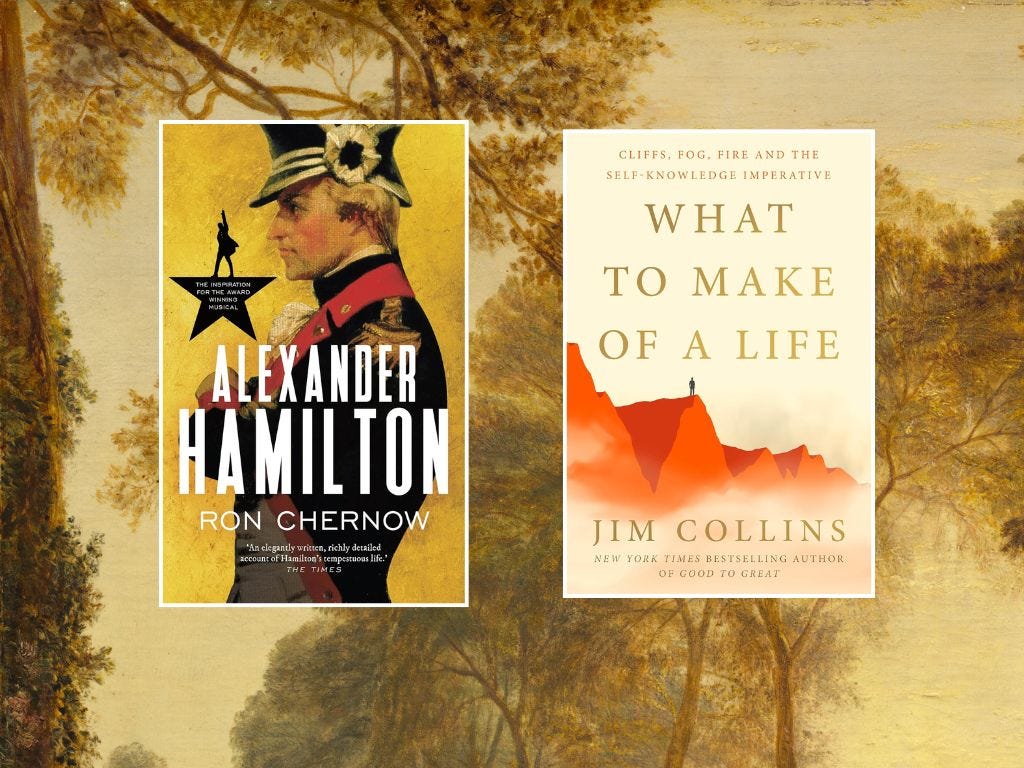
Alexander Hamilton by Ron Chernow - ‘I was born to die and my reason and conscience tell me it is impossible to die in a better or more important cause,’ he wrote in a letter. He was 19 years old and this was the late 18th century. He was joining the military against the British Empire. Here was the illegitimate and orphan son from the Caribbean who came to New York by the hand of his published writing and depth of ambition, without knowing that this next act was pulling him to glory. Not because of having the honor of dying for a country that’s not his, but because it was this step and his constant self-improvement imperative that took him to become George Washington’s aide-de-camp in the Continental Army, and then the rest became history. It’s easy to read this biography as a story about the rewards of relentless work, but what I also see is a man who decided to detach from his family’s painful identity and genuinely transform himself through his insecurities with the sole goal of going straight to the end in everything he was curious about, even during the worst and most helpless situations. This is the man who—aside from being a father, poet, congressman, lawyer, educator—founded the Bank of New York, drafted agreements with both France and Great Britain, wrote some of the most influential political papers (still being quoted by the Supreme Court today), became a catalyst and leader for the federalist party, and also America’s first treasury secretary. While reading this book I came across a line in Lin Manuel Miranda’s play asking “Why do you write like you’re running out of time?” And if I try to see it from Hamilton’s perspective I would ask “Why not?” He wasn’t in the right place and somehow he managed to get to a better one. He wasn’t in the right time and serendipity played in his favor. He could have been anyone, but he decided to read the ancients, finding wisdom in Plutarch, Hume, Bacon, Hobbes, Montaigne, Cicero. He recognised the injustices and needs of the colonies. He knew his capabilities and the ones he could grow towards. He saw his life not as his own but as one fitting in time with a job to make. As any human being he was also flawed in many ways, his political positions were fairly challenged in an America that lacked political structure, but also especially because he had an affair, which stained his political position forever and showed the view of the sharpest shadow in a world supposedly full of light. But there is so much to capture from Ron Chernow’s magnum opus work that can influence one’s life, as well as so much great context on the colonial times and issues, and the thoughts and flaws of the other American Founders and future presidents. I feel full after reading this book because it’s a clear reflection of the seeds and origins that drove America’s position in the next century, and as a young Hamilton writes in a love letter, “I challenge you to meet me in whatever path you dare”—A great reflection on the way that any life can abundantly change if there’s decisive endurance along the way.
What to Make of a Life: Cliffs, Fog, Fire and the Self-Knowledge Imperative by Jim Collins - When I moved countries for the second time I felt I had finished going through the path of fire. With a heart broken, work burnout, shame, pain, desperation, I came on the other side to the city of my dreams and then I thought that I’ve worked and moved around all my life to get here. I was as happy as I was concerned because for months I couldn’t see what’s next. You could think of a new job, a degree, overnight changes that come after jumping from a trampoline, or a million dollars finally accumulated at the front of your door. The job was finished, and I faced what Jim Collins describes as a fog. Waiting for a sign, a new dream that comes crashing on me? a new place to move? “You so often get where you are going by stumbling,” quotes Collins, “but you can only stumble if you are moving.” You can only see a few steps ahead of you, if one. I maxed out and I wasn’t in love with it. My calling expired, yet I had to look back to understand who I am. Over time I noticed how each of us are naturally good at some things, also joyful by doing them, also losing track of time when we do them, but that also, as many of you, we are not getting paid to do them. And maybe at some point you don’t do those things anymore, because you don’t have the time. Maybe you now have kids, or a mortgage to pay, or heavy commitments. Maybe you’re getting paid so well doing something that is making you deeply unhappy. So your life went in a different direction, you missed the bus… maybe for years, maybe for over a decade. Maybe you’re in your 40s, 50s, 60s? We wake up one morning and we think to ourselves that we can’t afford the change. Or at least that’s what we think. After all, there has never been a change that was not met with doubt. But what if I tell you that there’s clear evidence that you still have both the seeds and the time to do the change? That it’s proven that people’s lives don’t peak early but actually later in life? That the secret ingredients to get there are within you and your self-knowledge. What if you learn how to discover what you were encoded for, and you’re able to zoom out into a vast sea of stars that show all the things you are actually good at? What if you could actually change the formula for money and for time wasted? Even more, what if, maybe urgently, this is the only time, this life I mean, that you are going to be able to use those skills and naturally live a full life? This book is both the antidote and an urgent read of courage, and over and over illustrates that the greatest paradox is how short we feel life is and yet that “no wise person ever wanted to be younger.” Collins brought over 12 years of research and thousands of lives researched to identify the patterns in stories of serendipitous encounters and music bands that changed the world, writers that wrote their greatest prose after their 60s, presidents who achieved their peak after presidency, athletes and scientists that both looked through the same activity through their whole lives and others that changed their focus more than once, achieving success. Yes, we all have to try hard. We can’t take time back. There is deserved merit and sometimes incredulous luck. But also yes, life can bring tragedy, and sometimes longer tragedies—moments of fog and painful cliffs that are inevitable parts of life that demand us to know ourselves even more than when there’s clarity and peace. This book is a great representation to explain how true greatness exists in the tension of embracing reality while working towards who we constantly want to be.
I’d love to hear your thoughts on these ideas. The best books you can read come to you through word of mouth, so if you know good titles that relate, please share them! If any of these resonate with you, pass them along.