

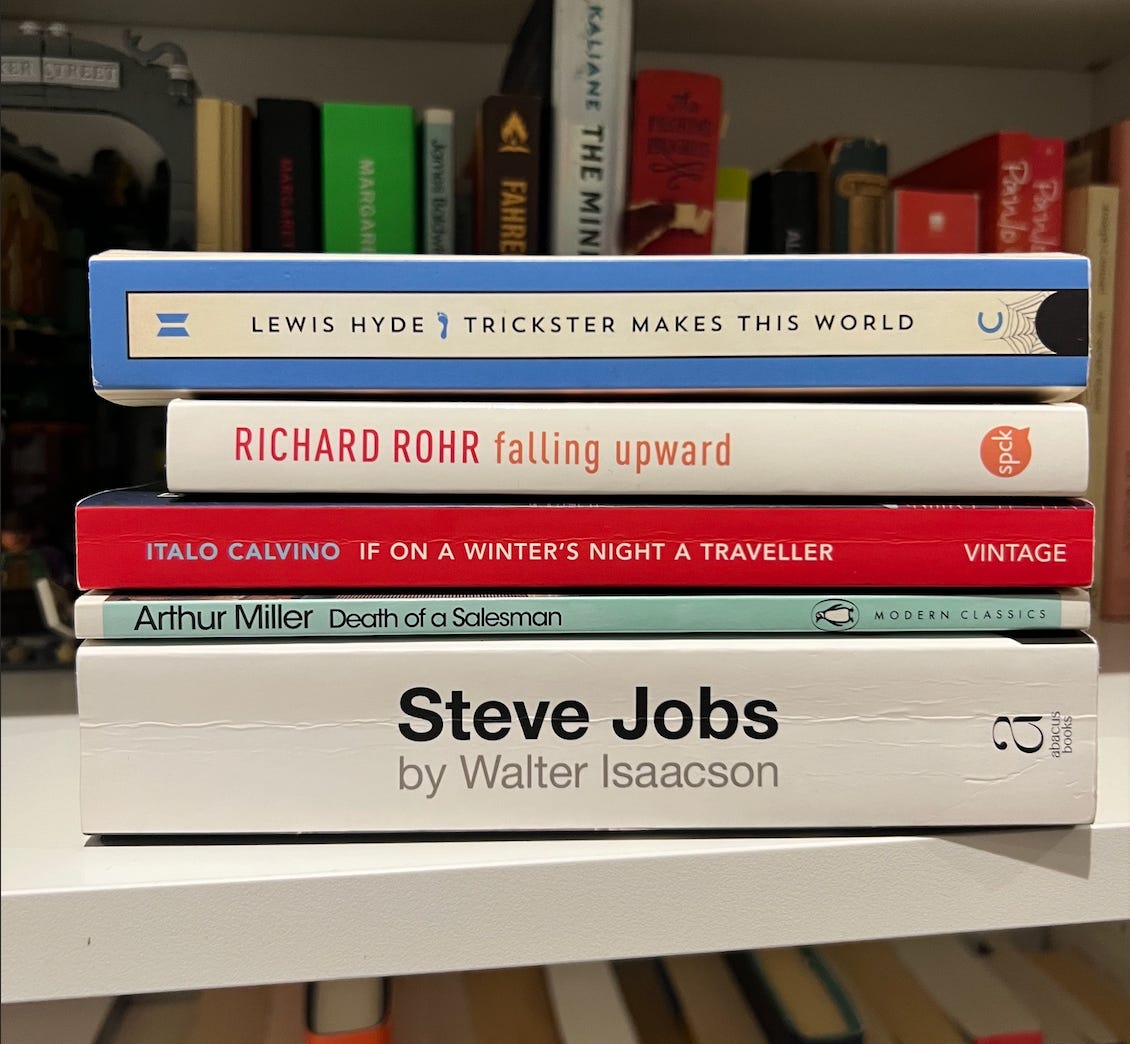
I found myself buying a new bookshelf this month and had the marvelous and basic idea to dedicate just one space to a lot of books that I want to have “pending” to read. It helped me spend less time selecting my next read. It started well before descending into chaos and running out of space. It’s the problem of wanting to read everything you’re interested in, but as they say, you buy books with the time it takes to read them. My goal this month was to expand my mind in literature, art and their conception in real world examples. It gave me a biography, a classic play, one of the most meta novels I’ve ever read, a spiritual book about the rest of our lives, and a great research explaining wonderful hints hidden from those who don’t want to see. I find it fascinating to combine different types of reads in short time windows because it gives you a broader sense of clarity and flavour to the things you find day to day, and if there is a message from my reading this month, it is to find ways to free yourself from repetition, either by reading new topics, making new things or finding a different way to approach a challenge.
Steve Jobs by Walter Isaacson - There’s this desire from everyone to discover “secrets” from genius people but when I read this biography all I can see is someone who was just weird, passionate, trying things, and consistently curious about everything. It reminded me of a recent podcast I heard where David Senra mentioned that the most successful people are those who look backward and say “That guy or that woman was great. How did they do that?” as Jobs did when studying Edwin Land, the founder of Polaroid, and Land in turn studied Alexander Graham Bell, and if you look back in American entrepreneurship it goes all the way to Benjamin Franklin. That is an enduring part of human nature that will never change. It’s going to happen while we’re alive. It’s going to happen 1,000 years from now. I also liked how Jobs positioned design and engineering teams together when he came back to Apple, building one of the most creative companies in the world and creating a model that influenced countless others. I was also surprised to learn how, almost by accident, he ended up meeting the most creative minds in modern animation, released Toy Story, and founded the Pixar we know today. Yes, he is a man with flaws, his family life wasn’t always great, he could be cruel as a leader, we all have learnings to take from that. But if there’s a message I take away from this book, it’s not to fall into patterns or keep doing the same thing. Instead, try to see the world differently and be a curious, obsessed explorer. As Jobs himself said, “The people who are crazy enough to think they can change the world are the ones who do.”
Death of a Salesman by Arthur Miller - This is a fascinating play that illustrates the myth that anyone can achieve success through hard work. Written in 1949, during a time of great optimism following the post-World War II boom in America, this play exposes the hidden costs of capitalism and the American Dream through the life of a man who spends thirty-six years as a salesman for a company and suddenly faces the threat of having his job and salary taken away. In this short play, Miller describes how pride, your greatest enemy, takes you to empty places as your obsessions with materialism and entitlement push away your family, mind, and spirit. With his two sons falling victim to his father’s high professional expectations, and a patronised wife who tries desperately to please him, Miller unravels the despair of a man whose sense of identity becomes lost when all he identified with was actually his work and his last name. There’s a trap in seeing successful people who’ve spent their lives accumulating wealth and status. They may look fulfilled, but they might actually be imprisoned by what they’ve built. As Miller says, “a small man can be as exhausted as a great man” and “no man only needs a little salary.” Now I understand why this play appears so often in history books and contemporary discussions. It captured something essential and perhaps very relatable to many about America’s post-war moment: the trap that lies within the Dream, and maybe the one we build in our own identities.
If On a Winter’s Night a Traveler by Italo Calvino - This novel was so hard and meta to read that I had to reread entire chapters multiple times to understand what was happening, and even though I did, I still didn’t understand what was going on. It’s both funny and tragic, it made me uncomfortable and desperate, but also submissive and giving, and that was exactly the point that Calvino wanted to make. The novel cues its beginning to then connect with a reader who is reading it, who then complains that the printing is wrong and the pages are jumping; and then you find yourself trying to find the exact book that can help you continue the story, beginning then a new thrilling story for a total of... ten times! The main character encounters different translators, historians and people he trusts along the way who tell him what to read to continue the story. And as you become frustrated and feel like giving up, Calvino says, “the romantic fascination produced in the pure state by the first sentences of the first chapter of many novels is soon lost in the continuation of the story, it is the promise of a time of reading that extends before us and can comprise all possible developments. I want to write a book that is only incipit, that maintains for its whole duration the potentiality of the beginning.” This novel reminded me that there’s a beauty in reading for the sake of reading, that the imagination of how things might continue is one of the greatest pleasures (where is the beginning really? where is the end?), and I highlighted many beautiful passages by letting myself get lost in the book. At one point, a conversation sparks between many readers in a library who start telling how each one reads, and one of them says, “of every book I manage to read no more than a few pages. But those few pages already enclose for me whole universes, which I can never exhaust.” A reminder I want to carry with me.
Failing Upward, a spirituality for the two halves of life by Richard Rohr - This book speaks to our need for spiritual maturity and how we are created with an inner drive and necessity that sends all of us looking for our true self. But our social structures block us from evolving on this path. The risk is that not exploring can mean spending the rest of your life stuck on issues of identity, security, sexuality and gender. But how do we start? Rohr describes life as split into two halves: the first half where we build structure and learn impulse control, traditions, family loyalties, basic respect for civil and religious principles, values and where you are from. The second half of life, ironically, is where you let go of your structure and ego, exploring mistakes and recognising your sins and gifts as two sides of the same coin. It is in the second half where you understand better the transrational: what goes beyond mere logic, or things that are bigger than ourselves, like love, death, suffering, God, and infinity. In our spiritual maturity, life ends up becoming a path that looks more like a spiral than a straight line. That is where we learn that, different from traditional dogmas and extremist views, entry into heaven is the rediscovery of the still-enchanted world of a happy child, but it now includes the maturing experiences of love, unique life journeys, the acceptance of all your relationships, and just enough failures to keep you honest and grounded. What impressed me most was learning about the different Bible passages that relate to these two halves and our need to “repent,” or change your mind; that each generation must make its own spiritual discoveries—otherwise, we merely react to the previous generation or conform without exploring. I also found it fascinating that most of us are only willing to put 5 percent of our present information into question, which is why most of the time only those who are the most open-minded and listening are the ones who are able to drive society to a better place. This book provides a path for all of us to try and do the same.
Trickster Makes This World, How Disruptive Imagination Creates Culture by Lewis Hyde - This is a wonderful and rich book about the trickster heroes found in myths across cultures. Think about Hermes, Coyote, the Cheshire cat from Alice’s Adventures in Wonderland, Achilles, Odysseus, Bart Simpson, The Joker, Loki, figures that break rules, mock authority, cross boundaries, hate rigidity, use cleverness more than strength. These figures vary not just in their stories but across cultures and national identities. I was fascinated to learn about America’s confidence man as a trickster, a figure representing the land of rootless wanderers and free market, of immigrants, of anyone who can shamelessly say anything at any time, of opportunity and therefore of opportunists, of individuals who are allowed and even encouraged to act without regard to community. I explored my own cultural heritage and countries where I had life experiences too: Venezuela with El Silbón, La Sayona; Lebanon with the Surviving Merchant, the Djinn; Chile with El Trauco, El Farolito. Each reflects different cultural concerns—survival intelligence, moral lessons, colonial resistance, deceptive seduction, taboo-breaking, erotic mischief, rural boundary transgression—ways of navigating between worlds. The nature of tricksters is to act on the periphery, never in the centre. They are not immoral but amoral figures that don’t fit into monotheistic religions with clear divisions between good and evil. They don’t have a single way, but they imitate and create many ways, and they all start from their curiosity, need for survival, and the instinct to test boundaries. I wasn’t aware of the complexity of these figures in our society, but after reading this book I’m fascinated by how they appear in every story and every tale, and their myths transform our imagination. The beauty of tricksters is that if we learn them well, we recognise them not only in modern literature and films, but in the people we most admire in real life for their ability to adapt, change and improvise to make an impact.
I’d love to hear your thoughts on these ideas. The best books you can read come to you through word of mouth, so if you know good titles that relate, please share them! If any of these resonate with you, pass them along.