

Our sense of tragedy comes from how we apply our virtues. It was A.C. Bradley’s view in the Shakespearean Tragedy that a tragic flaw is often the shadow side of a strength. In other words, our good qualities and sense of greater good could cause consequences that sometimes are unforeseen — but that doesn’t mean that we don’t need heroes.
People who challenge the status quo? Yes.
Refuse dishonesty, something or someone wrong when it’s necessary? That too.
This world is made of courage and examples of courage. Of cowards nothing is written. Nothing is praised. Nothing is remembered. ‘In this world goodness is destined to be defeated,’ wrote Walker Percy in The Moviegoer, ‘but a man must go down fighting. That is the victory. To do anything less is to be less than a man.’
Yet, dutiful as that may be, could all the calls to action be wise to take? Helen DeWitt wrote it in other words saying that ‘everyone can imagine a life’s regret for a moment of cowardice, but you could just as easily regret a moment’s courage.’
Scholars describe how four centuries B.C., Alcibiades, an Athenian in a position of power, had this same discussion with Socrates. The young Greek leader was claiming that he was ready to advise the Athenian assembly on when to fight and when to make peace. Socrates said that in such cases, ‘the question of justice and injustice must enter into peace and war; and he who advises the Athenians must know the difference between them.’ Socrates pointed out that if we ‘know’ about something, we must be aware of a time where we didn’t, and find an accurate way of learning. In this case, Alcibiades must either have been taught justice by some master, or found a way to discover the nature of justice himself. Instead, Alcibiades denied all of these and claimed that he had learned justice by observing the multitude—why can’t he learn justice in the same way that he can learn the Greek language from them? To this Socrates answered, that ‘multitudes can teach Greek, but they cannot teach justice; for they are agreed about the one, but they are not agreed about the other.’
Through a series of questions, Alcibiades is reduced to admitting how little he knows of politics. And Socrates teaches that even if other politicians could be just as ignorant, the dangers of not knowing and acting could bring consequences that are far from what justice needs.
How often do we fall into the same trick of thinking that we know the right thing to do but as we look back we often gloom over the mistakes we made? The scholar Benjamin Jowett wrote on the Socratic dialogues that the definition of good is narrowed by successive questions, and virtue is shown to be identical with knowledge. It follows that self-knowledge can be obtained only by looking into our acts and reflecting on our thinking.
Socrates doesn’t deny that good intentions can end badly, but rather tells us to spend time thinking of what we know before we act. How will our results look tomorrow, in one month, in one year? Can we know ourselves the same way an expert knows a field? Wisdom is where that begins, and it is what puts the other virtues in their place. This is also the theme of our reading list for September.
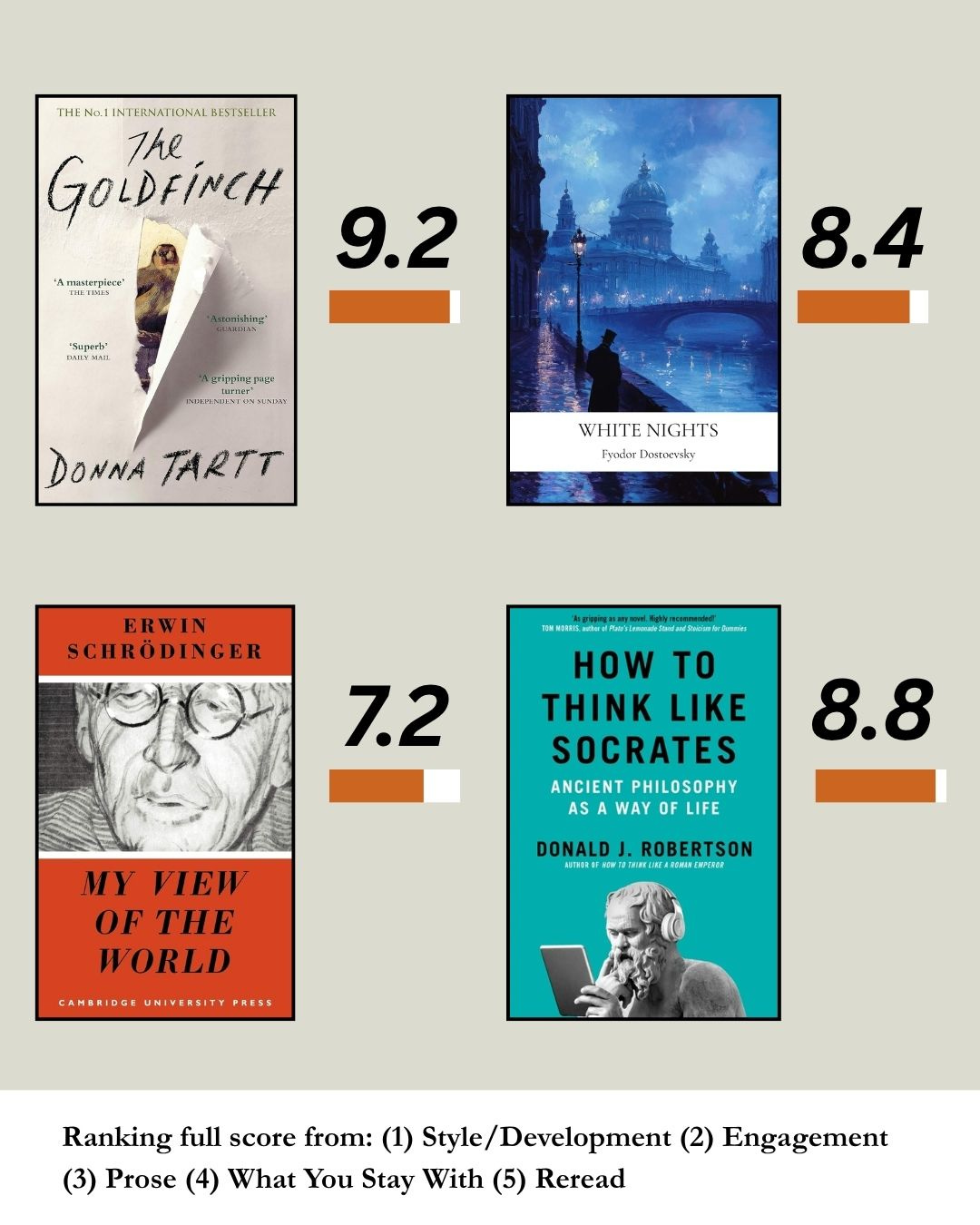
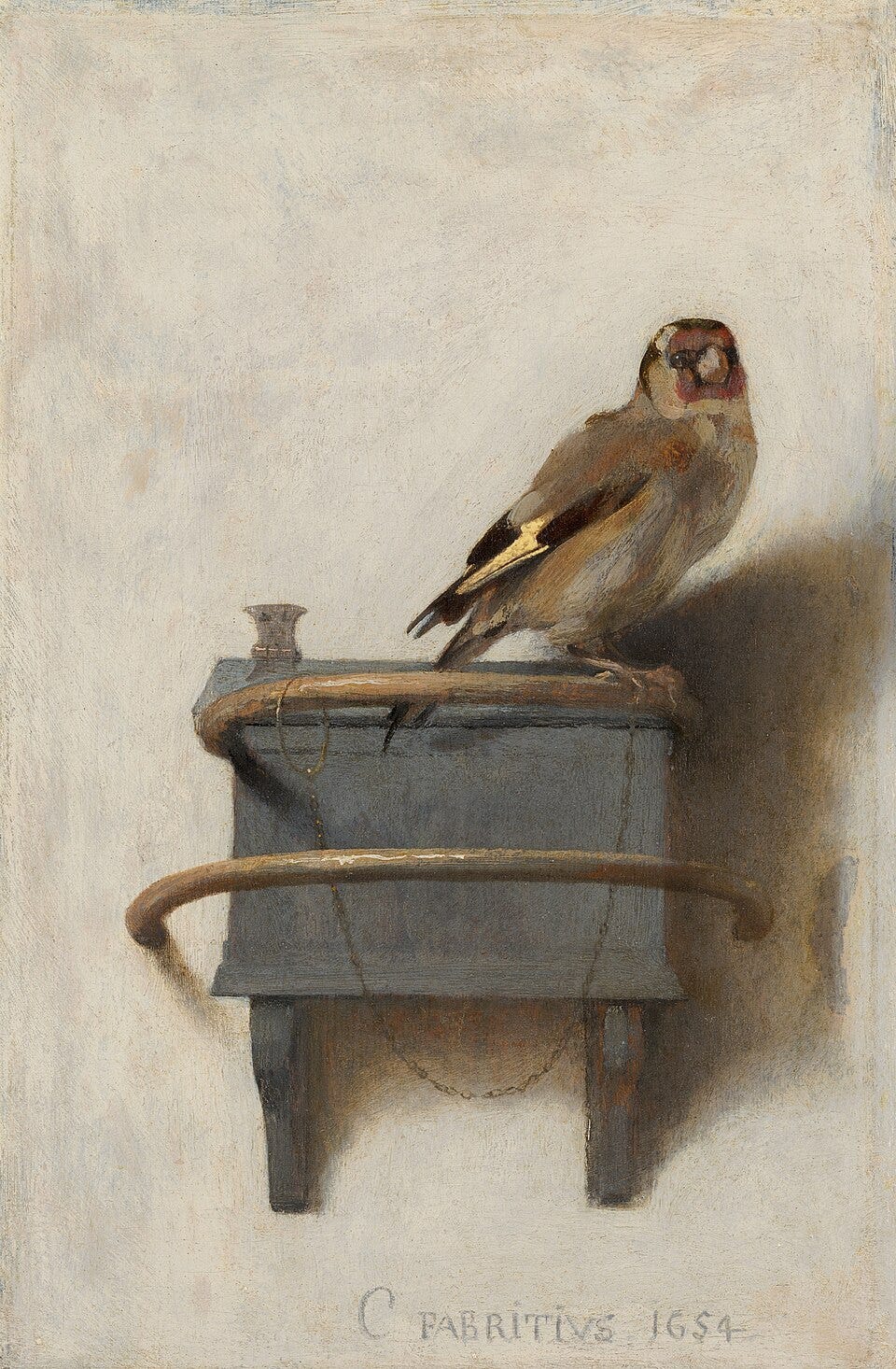
The Goldfinch by Donna Tartt - A boy, Theo Decker, is visiting the Metropolitan Museum of Art in New York with his artistic mother. As she walks him through the meaning of some of the most famous paintings from Dutch artists — Rembrandt, Coorte, Hals — she comes to Carel Fabritius’ Goldfinch, ‘this is just about the first painting I ever really loved,’ she says, and as the boy looks into it, it’s the simplest he’s seen so far: a yellow finch, against a plain, pale ground, chained to a perch by its twig of an ankle. Out of all Fabritius paintings, her mother explains, this is one of the few that survived an explosion in the 1600s, otherwise known as the disaster at Delft. Fabritius was killed in the accident, and his studio was destroyed, but the paint survived as the omen that overcame an accident. Standing before a painting of a chained bird, ‘one prisoner looking at another,’ Theo turns his gaze to a young captivating girl with an old man standing close-by watching the same painting. What happens after takes such an unexpected turn that takes you on a journey describing the power of trust, the turn of relationships, an exploration of identity and the drive to justify one’s own existence when we look at ourselves through time. What makes this novel incredible from the very first pages is Tartt’s detailed crafting in writing, deep research and the characters she creates. It is known that she spends roughly a decade between books. Her minimalist descriptive view for every scene — people, situations and cities, both physically and emotionally, along with the exploration of the odd sight of fate — leaves you deeply immersed and starting to feel that your day-to-day life has the same novelty of change. Theo carries with himself decisions with a high personal stake and a certain premise to consider that good doesn’t always follow from good deeds, nor bad deeds result from bad, despite that we think them through - as Tartt writes that ‘even the wise and good cannot see the end of all actions.’ It’s such a beautifully-made book, that strikes a chord as a painting itself. ‘Always remember,’ Tartt writes in a dialogue from a craftsman to Theo, ‘that the person we’re really working for is the person who’s restoring the piece a hundred years from now. He’s the one we want to impress.’ I can say that this book will be on the podium of classics of literature that will impress anyone who grabs it.
My View of the World by Erwin Schrödinger - ‘This life of yours which you are living is not merely a piece of the entire existence, but is in a certain sense the whole.’ Schrödinger is well known to the world as the physicist who discovered fundamental equations in quantum, most famously through the exercise where a cat in a sealed box is considered both alive and dead until observed. But in this book he writes as a poet and philosopher sharing his view on consciousness and the biggest problems in philosophy. He draws on the writings of the Vedanta — an Indian philosophy which asserts that the goal of life is to realize and to manifest our own divinity by our oneness: ‘Everything that you are seeing has, apart from small changes, been there for thousands of years before you.’ I find it fascinating to read the philosophical point of view of the greatest physicists of all time, because they are able to describe their clash between the real and wondrous — in other words, the sublime. Schrödinger makes a case for philosophical wonder through Greek philosophy and Eastern cultures, pointing out how we go through life taking actions risking our lives for an end which we believe to be good. In the process ‘the whole’ of evolution brings the wisest men into a duty to ‘change, overcome, and destroy,’ as ‘chisel-strokes’ on the ‘eternally unfinished statue of our species.’ What I keep going back the most from this read is the reasoning of our shared consciousness, not only about what we see and experience, either now or thousands of years back, but also our stresses, pains, fears, concerns. It’s almost as if we are set to live the same experiences but there is something that relates in how we read between the lines, and how we learn to ‘live them’ authentically by interpreting them differently. Could it be related to how we see it in a shared lens? It’s through this perspective that Schrödinger describes the wisest individuals as those who not only risk their lives, but in some cases, do it in full serenity, for an end they believe to be good for the whole, even to relieve a stranger’s suffering.
How to Think Like Socrates: Ancient Philosophy as a Way of Life by Donald J. Robertson - Sourcing from the only surviving accounts of Plato and Xenophon, this book is a work of research about the life journey of Socrates, one of the first philosophers and influencers on Stoicism who, coming from a humble family and a very curious personality, ends up uncovering our common weaknesses in knowledge and human nature four centuries B.C. Most of us have heard about the Socratic method and the benefits coming from self-inquiry with the popular aphorism ‘I know that I know nothing,’ and you might see this book as a tool for becoming a better ‘thinker.’ But Donald Robertson landed in something much more complex than self-help. Socrates’ greatest premise is the same that was scripted on a stone in the Temple of Apollo at Delphi: ‘Know thyself’ — not in the literal sense, but in the deepest assumptions of what we know and how we underestimate the quality of our decisions. Through the series of dialogues between Socrates and his contemporaries, this book makes you think hard about the preparedness for our roles and the understanding of our cardinal human themes: courage, discipline, justice, wisdom, emotions, death, the things that we specialise for and the things that we believe we know. One of the greatest learnings that I am applying from this book is seeing how often people believe their problem is one of being overcome by fear and desire, or pain and pleasure, instead of one of being overcome by ignorance. In other words, if you’re tempted to call a past outcome unavoidable, check whether the ignorance behind it could have been overcome by thinking more before acting, and you didn’t. ‘We go through life, for the most part, acting as if we know—or don’t need to know—what our goal should be, which things are good and which are bad,’ writes Donald J Robertson, ‘few of us ever take time to critically examine these assumptions.’ This is immediately a book I know I will come back to at least once every handful of months or per year, to remind me of my limitations and the ways I can act better next time.
White Nights by Fyodor Dostoevsky - I was compelled to read this short story to further understand the nature of love, I found it too painful, too uncontrolled by the end. Dostoevsky sets the scene in St. Petersburg, where a man, who describes himself as a ‘dreamer’ — in want of nothing more, yet ready to believe at certain moments that all of his life is authentic and real — becomes lonely over time because he is unable to engage his feelings and view of the world with anyone. Walking on a solstice night when the sun doesn't set completely, he encounters a woman sobbing, staring at the horizon. The scene places a lone man who wanders through empty streets, living more in his imagination than in reality, meeting a lady carrying her own melancholy and mystery, and the story unravels in four nights where their conversations become deeply intimate and affective, until things flee in a desperate feel of sadness and detachment. In a handful of pages a dreamer's hope meets an authentic feeling, until the man she has been waiting for returns and she goes to him. The dreamer's tragedy is not too much feeling but too little self-knowledge. Dostoevsky tries to describe the bittersweet and fleeting nature of love in individuals who can’t rely on their own self-perception and find, even in the shortest relationships, the strength of emotions that are uncontrolled and can change someone forever. ‘My God! A whole minute of bliss! Is that really so little for the whole of a man’s life?’ It almost feels like the ‘white night’ is the best expression of these feelings - showing the never-settling sun as the lingering that can’t ever be buried again.
As usual, I’d love to hear your thoughts on these ideas. The best books you can read come to you through word of mouth, so if you know good titles that relate, please share them! If any of these resonate with you, pass them along.