

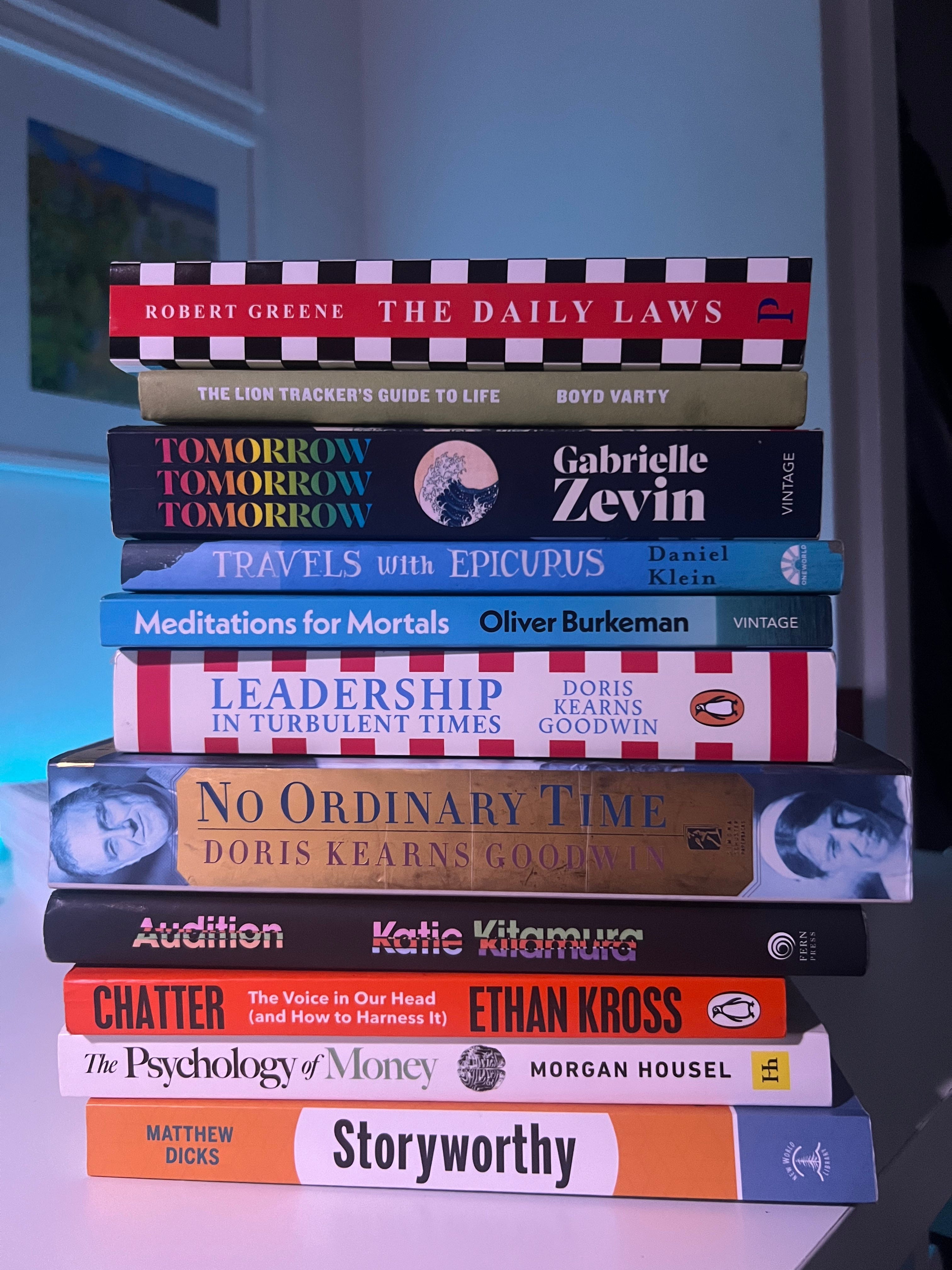
Tell me a book that marked your life? If you had to tell me what to read next, what would it be? Who is your favourite author? All these questions, and I really don’t know the answer, because I spend most of the time reading and being curious. Sometimes overwhelmed and dispersed; other times sharp-focused. And I truly don’t know if it is a privilege or just a hole in the process. I answer the questions by asking more questions. “What are you going through?” “What type of book has marked you before?” My replies leave me unsatisfied, unguided, unsure. I keep on planting a seed for a bigger question. I think in bulks, and periods, and people that affected me, and phases of my life.
In 2024, a book that broke my heart and made me more human was The Road by Cormac McCarthy. A book that helped me understand how to achieve my dreams was Mastery by Robert Greene, which changed my perception of my doubts and fears. When I wanted to learn about women who changed history, I read the biography of Florence Nightingale by Woodham Smith (one of the most enriching biographies I ever read and wrote about here). A book that taught me how to see the world differently is Same as Ever by Morgan Housel. Another book that helped me connect the dots spiritually is Becoming Wise by Krista Tippett.
I read and reread The Midnight Library by Matt Haig when I was sad about the outcomes of my decisions.
I read and reread Discipline is Destiny by Ryan Holiday when I wanted to become more accountable to myself.
I read and reread The Magic of Thinking Big by David J. Schwartz when I wanted to regain extraordinary ambition.
It wasn’t all worth it—over half of my reads are not books I’d want to read again. Do I regret it? No, not at all. I’ve discovered great writing, and I’ve discerned from it after reading more books. I evolve my thinking as I flip the pages. I’m changing my taste and becoming a more demanding reader. The books are part of my DNA. I’ve learned some things about them. I’m taking the knowledge that’s useful for me.
One book can change your way of seeing the world; a hundred can change your destiny. I’m aiming to record my impressions for every book I read in my lifetime, and it’s become my tradition to share them with you; so here are my top picks from 2025.
Storyworthy by Matthew Dicks - This is hands down one of the greatest books on life writing and storytelling. Dicks is a thirty-six-time Moth StorySLAM champion and five-time GrandSLAM champion. Imagine the Moth as a stand-up comedy, but rather than jokes, you’d have stories of transformation. This book walks you through the best tricks in storytelling you wouldn’t have read anywhere else, and in an obvious and exemplified fashion. One of the greatest lessons I learned was that all great stories - regardless of length, or depth or tone - tell a five-second moment that changes a person’s life fundamentally. Better yet, if we polish our lenses, we actually have these five-second moments every day. What the story helps us do is bring that moment to the greatest clarity possible. Furthermore, the opposite of the five-second moment is where your storytelling needs to start, as close to the moment of change as possible. After reading this book, I’ve been noticing so many patterns across movies, series, and the best jokes I’ve ever heard. Among the dozen activities that Matthew Dicks does as a columnist, playwright and blogger, he also acts as a teacher and cofounder of his own training program storyworthymd.com. I cannot recommend this book enough if you want to improve your storytelling.
The Psychology of Money by Morgan Housel - I’ve read this book three times, and I keep quoting Housel and recommending him all the time: I did it in my last year’s book recommendations, in my essay on invisible wealth, and in my writings about childhood and purpose. He is one of the best non-fiction writers around at the moment and one of my platonic mentors. The way he writes a story is worth studying—not if you’re into writing or any other similar act, but because we are all creatives by nature in the way we think and express ourselves. In The Psychology of Money he walks us through most of the myths around wealth. I indexed a lot of his ideas in my “investing” category, but I can say that they should all be holistic in decision-making. Beyond his good definition of investing genius - a person who can do the average thing when everyone around you is not - most of the concepts in this book are unique and unusual. His point on tail events, luck and risk, points of failures, surprises, and perspectives among ourselves. Also, his other book, Same as Ever, has no waste in reading. I am looking forward to reading his latest The Art of Spending Money.
The Daily Laws by Robert Greene - “Robert, you’re never going to be a writer,” his editor pointed to him one day while Robert was living in New York, “you need to find another career in your life. You need to go to law school. You don’t have the tools; your writing is all over the place. Just forget it.” Echoing the words afterwards, Greene faced it as not true. That the only truth was that he is not made for journalism—the big corporations, the politics, the fitted outcomes. His real conclusion was that you’ve got to know what you don’t like. He had over fifty jobs as he started writing his first book. Still, no one was really paying attention to his idea on the laws of power, until he worked as a writer in an art and media school in Italy, and met with a book packager who heard and encouraged Greene to continue. This marked a turning point in Robert’s life, and that’s how he published The 48 Laws of Power, one of the best books in history on persuasion, perception and politics. It was so powerful that it became banned in some prisons in the US. He then wrote the follow-up best sellers: The Laws Of Human Nature, The 33 Strategies of War, Mastery, The Art of Seduction. All of his books are works of art, but the book I ranked as top for me this year is The Daily Laws, published in 2021 as a collection of 366 meditations from all of Greene’s works. The book reads as one page daily, and there’s not a single one wasted. You can see that Greene’s success as an author wasn’t overnight; his path should resonate with anyone who feels rejected and far from any goal and dream envisioned, even when no one else recognises your work.
The Lion Tracker’s Guide to Life by Boyd Varty - Joseph Campbell said, “If you can see your whole life’s path laid out, then it’s not your life’s path.” A great and unconventional book on leadership that came out of Boyd’s experience as a safari guide in South Africa, which led him to become a life coach. As I look at my year of readings, I keep coming back to this book because all I can think about when things turn out negatively is Varty’s paradox on “going down a path and not finding a track is part of finding the track,” or in other words, the path of not here. This book is a light and wonderful read on the importance of finding your own tracker in life, and how we have forgotten that life holds a unique story for each of us. What I also appreciate about this story is the importance of hardship, or being in “the danger of no danger.” We are naturally made to face danger. The world is waiting for us to discover our path and be one of those masters who can use their intuition and be themselves in any situation, and also appreciate “look at the thing you have seen a thousand times and always see something new.” A highly recommended read, I learned about Varty by reading Martha Beck’s The Way of Integrity (also an amazing book).
Chatter: The Voice in Our Head (And How to Harness It) by Ethan Kross - Earlier this year, I was struggling to balance personal life with professional changes while battling impostor syndrome. I threw it out there to a friend, and her immediate response was, “You should read Chatter,” without a doubt. Every time someone I trust recommends a book to me, I try to order it immediately. What a book! We all have an inner voice, an avid time traveller and a relentless critic. Chatter is a form of repetitive, anxious thought and a marvellous saboteur that comes during focused tasks. How often do we revisit moments with guilt, pain, or regret over thoughts or things someone said to us? How often do we enter a meeting to say crucial things, an audition or a competition, only to feel like we are failing right from the start? Moreover, how much mental baggage do we carry from our family, friends, colleagues, and society, and how do we find ways to deal with it? From the way we engage with rituals, perspectives, and placebo effects, how to provide, receive, and create the environment for better support for chatter. It’s all in our heads, and Kross sorts it in his book with a clear, well-written framework and many ways to deal with the chatter in our minds.
Leadership in Turbulent Times by Doris Kearns Goodwin - This book is a mark in my life and is easily one of the best ones I have ever read. I’m drawn to American presidential history, and I have highlighted most of the pages. There’s not a single word of waste by the historian Kearns Goodwin. She brings a fascinating narrative of four presidents who shaped the nation during crucial periods: Abraham Lincoln during the 1862 Emancipation Proclamation, Theodore Roosevelt during the 1902 coal strike, Franklin D. Roosevelt during the 1933 Great Depression’s first 100 days, and Lyndon B. Johnson during the 1964 Civil Rights Movement. The fascinating part is how Kearns Goodwin masterfully connects the upbringings of each president, their sense of ambition, their intense adversities, and their methods of crisis management. The patterns across the book are striking, from Lincoln’s melancholy and constant depression to Teddy’s struggles with debilitating asthma to FDR’s ability to face poliomyelitis and keep his political life active to LBJ’s twenty-hour days and extraordinary skill at getting things done. The four of them maintain their ambition despite multiple failures. Each one offers lessons applicable to our own challenges. What’s more, the book combines their experiences with clear leadership principles from prominent academics and contemporary psychologists. This book rewards reading at any stage of life.
No Ordinary Time: Franklin and Eleanor Roosevelt: The Home Front in World War II by Doris Kearns Goodwin - Another masterful work from Kearns Goodwin, but this time on a deep dive to FDR’s evolution in relationships with European powers during the Second World War, and the challenges rising in America: war production, racism, women entering the workforce, Japanese internment camps, post-war plans, the case for the United Nations, among others. “The only thing to fear is fear itself,” said FDR after the Great Depression in the early 30’s, words that proved prophetic. This book illustrates the creation of Modern America and the sudden change in geopolitics. I enjoy reading the behind-the-scenes stories of impactful people and gaining insight into their humanity. I also wrote about it here. It also struck me to find Eleanor say, “to be nearly sixty and still rebel at uncertainty is ridiculous, isn’t it,” to an insomniac Franklin as he secretly confessed the military plans the night before D-Day, the invasion of France to recover from the Nazis.
Travels with Epicurus: Meditations from a Greek Island on the Pleasures of Old Age by Daniel Klein - This might be one of my favourite reads ever, and is perfect for an accessible yet profound entry into philosophy. I discovered it through Ryan Holiday, who highlighted this powerful passage: “I remember one long-ago evening, on an overcrowded train to Philadelphia, hearing a young woman moan to her mother, ‘God I wish we were there already!’ Her white-haired mother replied eloquently, ‘Darling, never wish away a minute of your life.’” Klein combines an academic background in philosophy and lived experiences, exploring the merits of old age while actually travelling to a Greek island. He covers a lot of ground in Epicureanism in very relatable terms, with close to 150 pages. His journey explores existentialism, our interpretation of time, moderation, solitude, relationships, among others.
Meditations for Mortals by Oliver Burkeman - Already one of my favourites this year. I am a big fan of the writings from Burkeman, and I subscribed to his newsletter “The Imperfectionist”. His previous book Four Thousand Weeks is one that I recommend to anyone who wants to grasp their own concepts of happiness by using philosophy and mortality as tenets. In his new book, Burkeman divides his writing into four blocks and invites us to read one chapter per day for four weeks and be contemplative about its meaning (I read them in one week). The blocks are split first by being finite; second, by taking action; third, by letting go; and fourth, by showing up. Although the concepts might sound repetitive to those of us who have been reading long stretches of modern philosophy content out there, I learned some really good perspectives in each block. There is this sense of feeling much better with myself after I read something from Oliver Burkeman. I praise his work, and I highly recommend it to everyone!
Tomorrow and Tomorrow and Tomorrow by Gabrielle Zevin - I couldn’t believe I let this sit on my bookshelf for so long. 478 pages that I couldn’t put down and therefore finished in three days. A contemporary fiction, this book explores deep complexities around relationships, virtues, ambition, dreams, philosophy, creative endeavours, addictions, tragedy, and above everything, love. I felt entertained and educated after it, and I’d recommend it to anyone, wherever they are in their walk of life. It gives insights into how we see the present when the past is only in our heads. Also, how are we playing our own life games in reality? A quote that stuck with me is “this life is filled with inescapable moral compromises. We should do what we can to avoid the easy ones.” Yes, it’s hard to face life in different circumstances and find ourselves making choices that could be ethically imperfect: taking a shortcut, ignoring a principle, benefiting from something or someone. But can we avoid those decisions that we can see clearly? When everyone is sick, we no longer consider it a disease. Not speaking up when we need to, pretending it’s not your problem because you’re not in the spotlight. If that’s the case and we are playing, what decisions can we change for the better today?
Audition by Kate Kitamura - I just can’t stop thinking about this novel because of how visceral it is. It grabs you, shakes you, and then throws you back to the real world. It opens with an older woman meeting a young man in a restaurant, and as they finish ordering, she says what she needs to say, then turns towards the door, and everything spirals into a frenzy. As you start to follow the plot flipping pages, there’s a sudden shift, a signal pointing that time has been wasted far enough. Then Kitamura forces you to ask: what’s the point of a performance? Is it that it allows us to live in a different world, or just the hypocrisies of our desire? Is it to hide emotions from us or to get closer to them? Rituals, relationships, dialogues, roles, spaces, fictions we get trapped in, sometimes even in our own houses. Kitamura points out how we are all seeking the same thing: to know that we exist in the world, the most fundamental validation. But in the process, we build our own sense of self, patterns emerge, and our perceptions start to take shape, too. Anything you observe, any way you watch yourself act, how you hear yourself speak and then articulate again—what you leave behind is mostly emptiness. It is then that you become aware of the unknown surrounding you.
I find joy in sharing these impressions with you after reading dozens of books in one year. But if you’re just starting on your reading journey, or you are intimidated by the load you see ahead, just remember it’s page by page. There’s no shortcut, just investing time in all those things that are making the greatest difference to you and will bring success, as you define it. The more you do that, the more successful you will be. Such is the case with reading books, and I’m committed to reading and indexing learnings in as many books as I can in the coming weeks, months and years.
Join me in sharing your thoughts on these ideas, and tell me what your greatest reads for 2025 are? The best books you can read come to you through word of mouth, so if you know good titles that relate, please pass them along.